
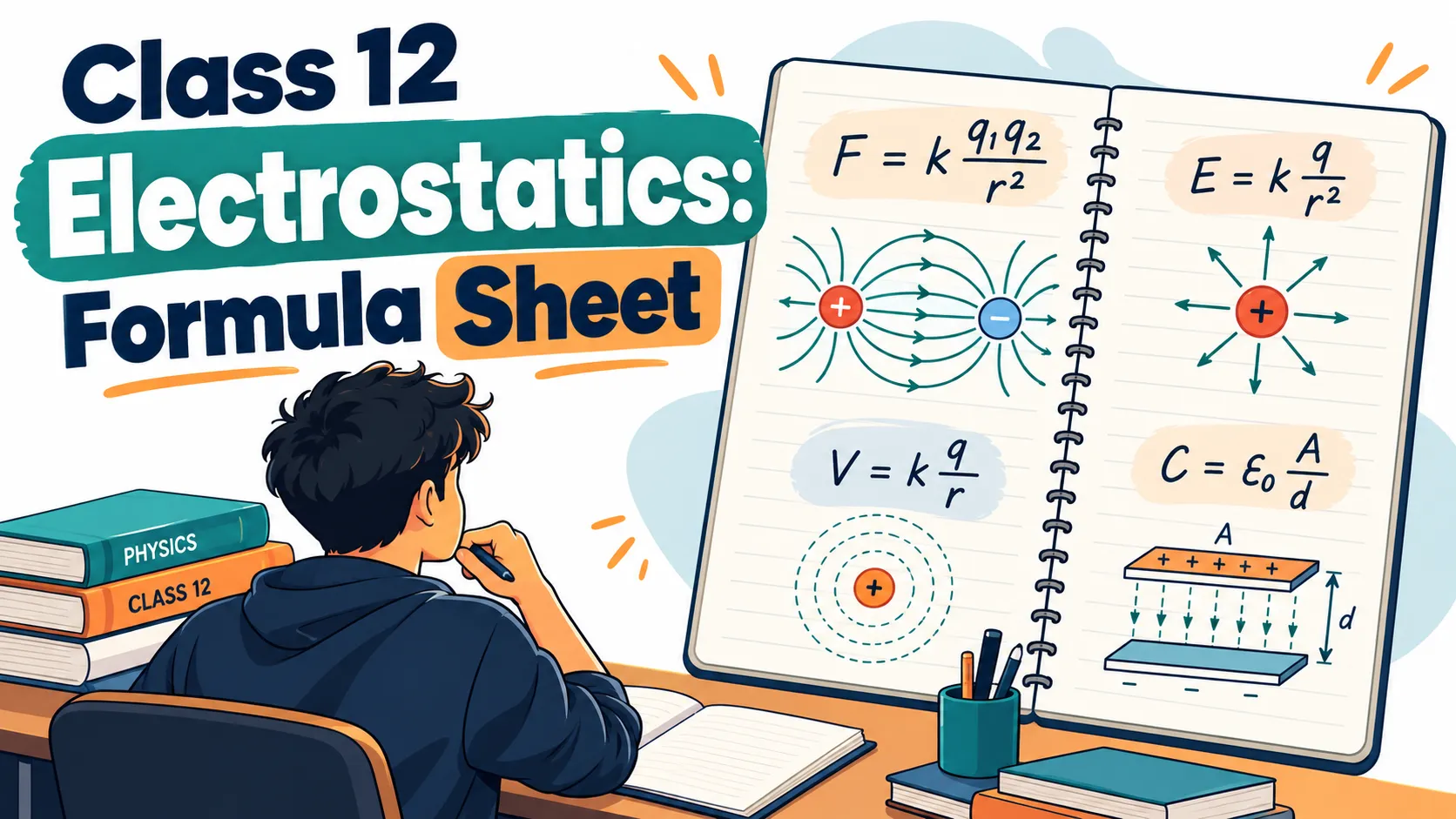
Electrostatics opens the Class 12 Physics textbook, and it’s one of the most predictable parts of the board paper. The same derivations, the same Gauss’s law applications and the same capacitor numericals turn up year after year — only the numbers and the wording change. Once you know what’s coming, it’s one of the easiest units to score full marks in.
These class 12 electrostatics notes cover both NCERT chapters — Electric Charges and Fields and Electrostatic Potential and Capacitance — with a complete formula sheet, the derivations you must be able to write from memory, and the question types that keep coming back in CBSE board papers.
How Much Is Electrostatics Worth in the Board Exam?
In the CBSE Class 12 Physics curriculum for 2026-27, Electrostatics (Unit I) and Current Electricity (Unit II) together carry 16 of the 70 theory marks. That’s close to a quarter of the paper from three chapters — and Electrostatics has the heavier share of derivations.
The 2026-27 Physics sample paper shows how it’s spread out: a 1-mark MCQ on Gauss’s law and flux, a 2-mark question on work done and potential, and a 5-mark long answer on capacitors or potential gradient. In other words, electrostatics shows up in every section, from 1 mark to 5.
Keep the Class 12 Physics NCERT Solutions open as you work through these notes — every formula below maps to solved exercise questions there.
Chapter 1: Electric Charges and Fields — Key Ideas
- Charge is quantised and conserved. Any charge is a whole-number multiple of e (1.6 × 10⁻¹⁹ C), and the total charge of an isolated system never changes.
- Coulomb’s law and superposition. The force between two point charges follows an inverse-square law. With several charges, find each force separately and add them as vectors — most wrong answers here come from adding magnitudes instead of vectors.
- Electric field and field lines. Field lines start on positive charges, end on negative charges, never cross, and are always perpendicular to a conductor’s surface.
- Electric dipole. Two equal and opposite charges separated by 2a. The dipole moment p = q × 2a points from −q to +q. In a uniform field, a dipole feels a torque but no net force.
- Electric flux and Gauss’s law. The total flux through a closed surface depends only on the charge enclosed — not on the surface’s shape or size. This single idea answers a large share of the MCQs and assertion-reason questions.
Formula Sheet: Electric Charges and Fields
| Quantity | Formula |
|---|---|
| Coulomb’s law | F = kq1q2/r2, where k = 1/4πε0 = 9 × 10⁹ N m2 C-2 |
| Field of a point charge | E = kq/r2 |
| Dipole moment | p = q × 2a (from −q to +q) |
| Dipole field, axial line (r ≫ a) | E = 2kp/r3, along p |
| Dipole field, equatorial line (r ≫ a) | E = kp/r3, opposite to p |
| Torque on a dipole | τ = p × E, so τ = pE sin θ |
| Electric flux | Φ = E · A = EA cos θ |
| Gauss’s law | Φ = qenclosed/ε0 |
| Infinite line charge | E = λ/2πε0r |
| Infinite plane sheet | E = σ/2ε0 (independent of distance) |
| Thin spherical shell | Outside: E = kq/r2; inside: E = 0 |

Chapter 2: Electrostatic Potential and Capacitance — Key Ideas
- Potential is a scalar. Unlike field, potentials from several charges simply add with their signs — no vector diagram needed. That makes potential questions faster than field questions, if you keep track of the signs.
- Field and potential are linked. E = −dV/dr: the field points in the direction in which potential falls fastest. Equipotential surfaces are always perpendicular to field lines, and no work is done moving a charge along one.
- Conductors in electrostatics. Inside a conductor the field is zero, any excess charge sits on the outer surface, and the whole conductor is at one potential. This is why a car’s metal body protects you from lightning.
- Capacitors and dielectrics. A capacitor stores charge and energy. Inserting a dielectric of constant K increases its capacitance K times — but what happens to charge, voltage and energy depends on whether the battery is still connected.
Formula Sheet: Potential and Capacitance
| Quantity | Formula |
|---|---|
| Potential of a point charge | V = kq/r |
| Potential of a dipole (r ≫ a) | V = kp cos θ/r2 (zero on the equatorial line) |
| Field from potential | E = −dV/dr |
| Potential energy of two charges | U = kq1q2/r |
| Dipole in a uniform field | U = −pE cos θ |
| Capacitance | C = Q/V |
| Parallel plate capacitor | C = ε0A/d; filled with dielectric: C = Kε0A/d |
| Dielectric slab of thickness t | C = ε0A/[d − t(1 − 1/K)] |
| Series combination | 1/C = 1/C1 + 1/C2 + … |
| Parallel combination | C = C1 + C2 + … |
| Energy stored | U = ½CV2 = Q2/2C = ½QV |
| Energy density | u = ½ε0E2 |
Derivations You Must Be Able to Write for Boards
Derivations are where electrostatics marks are won or lost. The CBSE marking scheme awards marks step by step — in the 2026-27 Physics marking scheme, a 2-mark potential question is split into four half-mark steps. So a derivation with a labelled diagram and clear steps can earn most of its marks even if you slip at the end.
- Field of a dipole on the axial line and on the equatorial line — the most repeated derivation in the unit.
- Torque on a dipole in a uniform field, and the work done in rotating it.
- Gauss’s law applications: field due to an infinitely long straight wire, a uniformly charged infinite plane sheet, and a thin spherical shell (inside and outside). Always draw the Gaussian surface.
- Potential due to a point charge and due to a dipole.
- Potential energy of a dipole in a uniform electric field.
- Capacitance of a parallel plate capacitor, with and without a dielectric between the plates.
- Series and parallel combinations of capacitors, and the energy stored in a capacitor.
Write each derivation out in full at least three times before the pre-boards — once with the textbook open, then twice from memory. Our Class 12 Physics revision strategy explains why writing, not reading, is what makes derivations stick.
The Question Types That Keep Coming Back
1-Mark MCQs and Assertion-Reason
Usually conceptual: what happens to the flux if the Gaussian surface is doubled in size (nothing, if the enclosed charge is the same), why the field inside a conductor is zero, or why two field lines never cross. Knowing the key ideas above answers most of these in seconds.
2- and 3-Mark Short Answers
Expect work done in moving a charge between two points, potential at a point due to several charges, a Gauss’s law application, or a short capacitor combination numerical. These reward neat steps: write the formula, substitute with units, then simplify.
4-Mark Case-Based Questions
A short passage — often about capacitors in a camera flash, a touchscreen or a defibrillator — followed by linked questions. Read the whole passage once before answering; the later parts often reuse a value from the first.
5-Mark Long Answers
Almost always a derivation followed by a numerical: parallel plate capacitance with a dielectric, dipole field, or a Gauss’s law application, then a calculation using the result. The 2026-27 sample paper’s 5-mark question combines capacitor behaviour with finding the minimum and maximum capacitance of three capacitors.

The Dielectric Question Most Students Get Wrong
| After inserting a dielectric (K) | Battery connected | Battery disconnected |
|---|---|---|
| Capacitance C | Becomes KC | Becomes KC |
| Voltage V | Stays the same | Becomes V/K |
| Charge Q | Becomes KQ | Stays the same |
| Energy stored U | Becomes KU | Becomes U/K |
The rule behind the table: with the battery connected, voltage is fixed; with it disconnected, charge is fixed. Decide which one is fixed first, and everything else follows.
Common Mistakes That Cost Marks
- Dropping the sign of a charge when calculating potential or potential energy. Keep signs in; they decide whether work is positive or negative.
- Forgetting unit conversions. μC to C (× 10-6), cm to m and cm2 to m2 cause more lost marks than the physics does.
- Missing directions. Field and dipole moment are vectors — state the direction in words or on the diagram.
- Skipping the Gaussian surface in the diagram. Examiners look for it, and it usually carries marks of its own.
Track which question types you keep getting wrong with the practice tracker below. If you use an AI tool to check your long answers, read our comparison of AI answer checkers and CBSE examiner grading first, and see how AI tutors can help you learn from mistakes.
How to Fit Electrostatics into Your Revision
Electrostatics is high-weightage and derivation-heavy, so it belongs in the first week of revision. If you’re following our 6-week pre-board revision plan, give these two chapters a full block in Cycle 1, then return to the derivations and dielectric questions in Cycle 2.
The calculus and vector skills in this unit overlap with Maths, so the Class 12 Maths NCERT Solutions are worth a look if integration or vector notation slows you down. And if you’re also preparing for JEE Main, electrostatics is one of the most tested Physics topics there too — our guide on cracking entrance exams without coaching shows how to build on board-level preparation.
Frequently Asked Questions
Electrostatics (Unit I) and Current Electricity (Unit II) together carry 16 of the 70 theory marks in the CBSE 2026-27 curriculum. Electrostatics questions appear in every section of the paper, from 1-mark MCQs to 5-mark long answers.
The field of a dipole on the axial and equatorial lines, the three Gauss’s law applications (line charge, plane sheet, spherical shell), and the capacitance of a parallel plate capacitor with and without a dielectric. Learn these to the point where you can write them from memory.
It feels hard at first because it is abstract, but it is one of the most predictable units in the paper. The same ideas and derivations repeat every year, so steady practice with the formula sheet and past questions makes it a scoring unit.
Final Takeaway
Electrostatics rewards preparation more than talent. Learn the two formula tables, write the key derivations until they come automatically, and practise each question type — especially the dielectric question — until you can tell at a glance what stays fixed and what changes.
Download the formula sheet, derivations checklist and practice tracker above, and keep Class 12 NCERT Solutions and Revision Notes bookmarked for the rest of the Physics syllabus.
Leave a Reply