
There is a familiar moment during board exam preparation.
A student finishes a chapter test, checks the answers and gets 16 out of 20 correct.
The four wrong answers are marked. The correct solutions are read. Maybe a few corrections are written in the notebook.
Then the student moves on.
A week later, a slightly different question tests the same idea — and the same mistake appears again.
The problem was not a lack of practice. The student practised, checked the answers and reviewed the solutions.
What was missing was understanding why the mistake happened in the first place.
For Class 10 and 12 students preparing for CBSE exams, this is one area where AI tutors can be genuinely useful. Not because they can generate answers faster, but because they can help students turn mistakes into information about what they need to learn next.
Not every wrong answer means the same thing
When students check a test, mistakes often get treated equally.
Wrong is wrong.
From a learning perspective, however, two incorrect answers can reveal completely different problems.
A student may get a Physics numerical wrong because they:
- did not understand the underlying concept;
- selected the wrong formula;
- used the right method but made a calculation error;
- forgot to convert the units;
- misread what the question was asking.
Those mistakes should not all lead to the same response.
If the concept itself is weak, the student may need to revisit it.
If the concept is understood but the formula was applied incorrectly, another explanation of the entire chapter may be unnecessary.
And if the only problem was an arithmetic error, rereading several pages of theory probably will not help.
The first useful question after getting something wrong is therefore not simply:
“What is the correct answer?”
It is:
“Why did my answer go wrong?”
Start with the student’s attempt
This is where an AI tutor can do something a traditional answer key cannot easily do.
Instead of only comparing the final answer with the correct one, AI can work with the student’s attempt.
Imagine a Class 10 Maths student solving a quadratic equation.
The first three steps are correct, but an error appears while factorising the expression.
Showing the student a complete solution from the beginning may fix the question, but it does not acknowledge that most of their reasoning was already correct.
A more useful response would be:
“Your approach is correct until this step. Check the two numbers you selected for factorisation.”
Now the student knows where the problem begins without having the rest of the thinking done for them.
That distinction matters because good correction should preserve what the learner already understands while focusing attention on what actually needs improvement.
Ask for a hint before reading the solution
When students get stuck during practice, the easiest option is often to open the solution immediately.
But there is another approach.
Ask for a hint.
Suppose a Class 12 Physics student cannot solve a numerical.
Instead of:
“Solve this question.”
they could ask:
“Here is what I have tried. Give me one hint about where I should look next, but don’t give me the final answer.”
If the first hint is not enough, ask for another.
Only move to a full explanation when necessary.
This creates a useful progression:
Attempt → identify the difficulty → hint → retry → explanation if needed
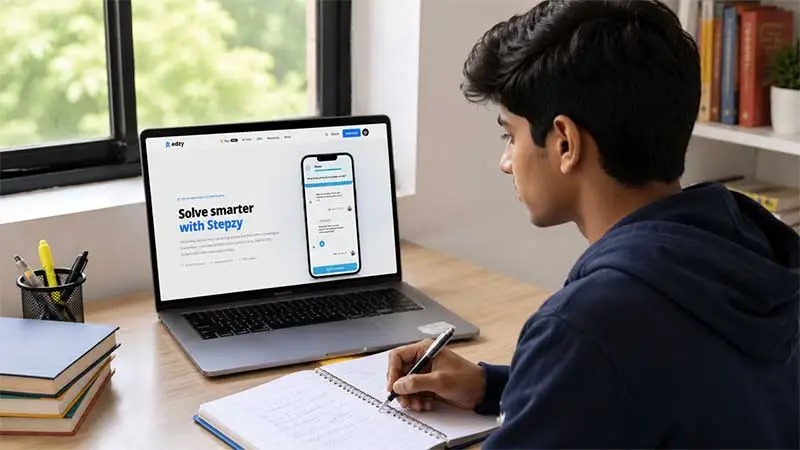
Tools designed specifically around this approach can make the interaction easier. For example, Stepzy works from a student’s attempt and provides step-by-step guidance around what is correct, what needs improvement and where the reasoning has gone wrong, rather than immediately revealing the final answer.
The important idea is not the tool itself. It is the habit: give yourself another opportunity to solve the problem before reading the finished solution.
Look for patterns across mistakes
One wrong answer tells you about one question.
Several wrong answers can tell you something much more useful.
Imagine a student gets four Physics numericals wrong across two chapters.
Looking at them individually, they appear to be four separate mistakes.
But after reviewing the working, the student notices something: in three of the four questions, the formula was correct but the units were not converted before substitution.
That changes the diagnosis.
The student does not necessarily have four weak topics. They have one recurring habit that is costing marks in multiple places.
AI can help students look for these patterns.
After completing a test, they can group mistakes and ask questions such as:
“These are the five questions I got wrong. Do you notice a common type of mistake?”
Or:
“Which of these errors are concept gaps and which are calculation or application errors?”
The purpose is not to let AI judge every answer automatically. It is to make the student’s revision more targeted.
Unit conversions cause many of these errors in electrostatics numericals (μC to C, cm² to m²), so keep our electrostatics formula sheet beside you while you practise.
Turn every important mistake into another question
Reading the correct solution can create a dangerous feeling:
“Yes, that makes sense now.”
Understanding a solution while looking at it is not the same as being able to produce the reasoning independently.
There is a simple way to test whether the mistake has actually been fixed.
Try another question.
After reviewing an incorrect answer, ask:
“Give me a different question that tests the same concept. Don’t show the solution yet.”
Then solve it without assistance.
If the new question is correct, that is evidence that the correction helped.
If the same error appears again, the weakness probably needs more attention.
This creates a stronger revision loop:
Make a mistake → understand it → correct it → practise the concept again → check independently
The last two steps are often what turn correction into actual learning.
For ready-made prompts that turn a mistake into a fresh set of questions, see how to use AI to make practice questions.
Keep a mistake log during board preparation
Students do not need sophisticated software to benefit from this approach.
A simple notebook or spreadsheet can work.
After each mock test or chapter practice session, record:
Question/topic: What was being tested?
Type of mistake: Concept, application, calculation, memory or misreading?
Why it happened: What specifically went wrong?
Fix: What should you remember or do differently next time?
Retest: Could you solve a similar question later without help?
Over time, this becomes more useful than a list of test scores.
A score tells you how you performed.
A mistake log starts telling you why you performed that way.
That distinction becomes particularly valuable as board exams approach and revision time becomes limited.
Use AI to prioritize revision, not just create more material
Students already have plenty to revise.
The problem is often deciding what deserves attention first.
Suppose a Class 10 student has completed several Science chapter tests. Instead of asking AI to create another generic study plan, they can use their actual mistakes as the starting point.
For example:
“These are the concepts I repeatedly got wrong over my last three tests. Help me group them into areas I should revise first.”
Now the revision plan is based on evidence from the student’s own performance.
The same principle works for Maths, Science, Social Science and other subjects.
AI becomes more valuable when it helps students make sense of their learning history rather than simply producing more notes, questions and summaries.
Do not use AI during every practice session
There is still an important stage where students should practise without help.
During a timed sample paper, AI should not be sitting beside every question.
The purpose of mock tests is partly to discover what happens when the student has to recall and apply knowledge independently.
Complete the paper first.
Then use textbooks, solutions, teachers or AI tools during the review.
This creates a healthier sequence:
Practise independently → identify mistakes → diagnose them → get help → practise again
If AI is present before the student has genuinely attempted the task, it becomes harder to know what the student can actually do.
The goal is not to eliminate mistakes
Students preparing for Class 10 and 12 board exams sometimes see every wrong answer as bad news.
During practice, the opposite can be true.
A mistake discovered weeks before an exam is an opportunity to fix something before marks depend on it.
The real problem is not making mistakes.
It is making the same mistake repeatedly without understanding why.
AI tutors can help students break that cycle when they are used for diagnosis, hints, explanations and follow-up practice rather than simply producing correct answers.
After every important mistake, ask:
What went wrong?
Why did it go wrong?
What do I need to change?
Can I solve a similar question now without help?
If students can answer those four questions, a wrong answer has already become more useful than a red cross on a page.
And during board preparation, learning from the questions you get wrong can sometimes be just as important as practising the ones you already know how to solve.