
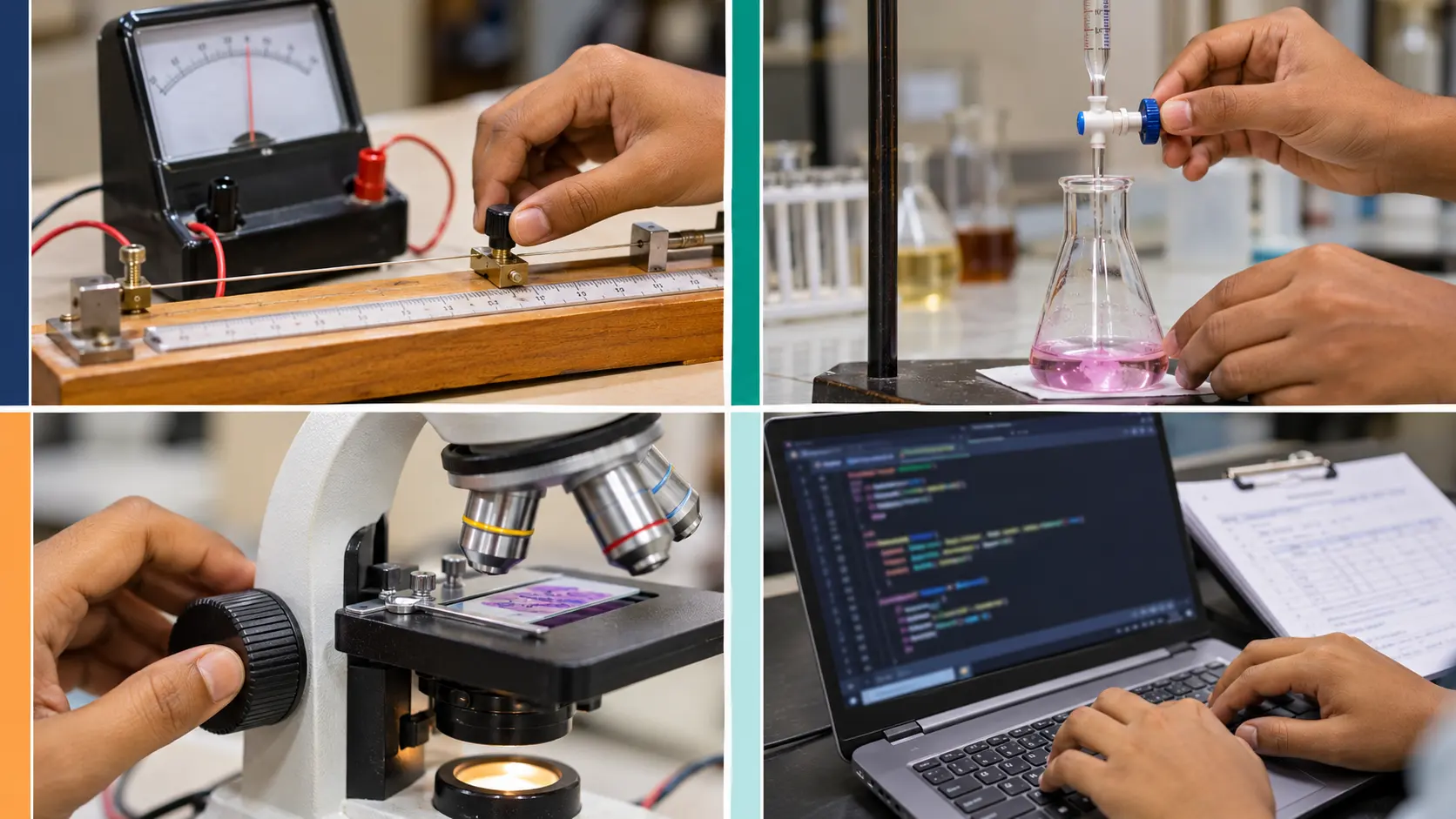
In Class 12 Physics, Chemistry, Biology and Computer Science, 30 of the 100 marks come from the practical exam. Those are some of the easiest marks of the year to secure, yet students lose them every year to an incomplete practical file, a rushed project or a nervous viva.
This guide to Class 12 practical exam preparation covers everything you need before the CBSE practicals begin: the dates, how the 30 marks are split in each subject, a practical file checklist, how to finish the investigatory project, and the viva questions examiners ask most often.
When Are the CBSE Class 12 Practical Exams in 2027?
For schools on the regular session, CBSE’s practical exams, project assessment and internal assessment for 2026-27 begin on 1 January 2027, according to CBSE’s November 2026 notice. Winter-bound schools hold them from 9 November to 19 December 2026. Your school will tell you the exact date for each subject, and CBSE appoints an external examiner who conducts the exam with your teacher.
That leaves about six weeks if your school follows the regular calendar. The practicals also overlap with pre-boards, so it pays to finish your file and project by mid-December. Our 6-week pre-board revision plan leaves room for this if you block out two evenings a week now.
How the 30 Practical Marks Are Split
| Subject | Experiment / test | Record and project | Viva |
|---|---|---|---|
| Physics | Two experiments, one per section (7 + 7); one activity (3) | Practical record (5); investigatory project (3) | 5 |
| Chemistry | Volumetric analysis (8); salt analysis (8); content-based experiment (6) | Project work (4) | Class record and viva (4) |
| Biology | Major experiment (5); minor experiment (4); slide preparation (5); spotting (7) | Practical record + viva (4); investigatory project, project record + viva (5) | Included with record and project |
| Computer Science | Python program (8); 4 SQL queries (4) | Report file (7); project (8) | 3 |
Notice how much of the total doesn’t depend on the experiment going perfectly on the day. In Physics, the record, project and viva add up to 13 of 30 marks. In Computer Science, the report file and project alone are worth 15. That’s why the preparation that matters most happens before the exam.
Your Practical File Checklist
Examiners check the file before or during the viva, so an incomplete file shapes their first impression of you. Make sure it has these:
- The required number of entries. Physics needs at least 8 experiments (4 from each section) and 6 activities (3 from each section). Computer Science needs at least 15 Python programs, 5 sets of SQL queries and 4 Python–SQL connectivity programs. For Chemistry and Biology, follow your teacher’s list.
- A complete index. Number every experiment, add the date it was performed and leave a column for your teacher’s signature.
- The standard format for each experiment. Aim, apparatus, theory or principle, diagram, observation table, calculations, result, precautions and sources of error.
- Labelled diagrams and graphs. Draw diagrams in pencil on the blank side. Graphs need a title, labelled axes with units and a sensible scale.
- Results with units and significant figures. “Resistance = 4.8 Ω”, not “4.8”.
- Your teacher’s signature on every entry. Get pending entries checked before the winter break, not on the day before the exam.
Finishing the Investigatory Project
The project is worth 3 to 8 marks depending on the subject, and it’s often the part students leave too late. A good project report follows the same structure in every science subject:
- Certificate and acknowledgement. Your school usually gives a format for the certificate.
- Aim and introduction. One clear question you set out to answer.
- Materials, procedure and observations. Include real readings or photographs of your own set-up.
- Result, conclusion and bibliography. Cite your NCERT textbook and any other source you used.
Do the project yourself and be ready to explain every page. Examiners can tell quickly when a student is presenting a downloaded or bought report, and the viva marks depend on your understanding. If you use AI to help brainstorm or check your writing, follow the rules in our guide on whether using ChatGPT for homework is cheating and say how you used it.

Subject-Wise Tips for the Exam Day
Physics
Write the formula, a neat circuit or ray diagram and a blank observation table before you touch the apparatus. Take at least five or six readings and plot the graph on the spot. If you’re revising the theory alongside, our Class 12 electrostatics notes cover the same concepts examiners link to in the viva.
Chemistry
For volumetric analysis, get two or three concordant readings and show the full calculation of molarity or strength. For salt analysis, write each test, observation and inference in a table and don’t skip the preliminary tests. For organic tests in the content-based experiment, our organic reaction mechanisms guide is useful revision.
Biology
Spotting carries 7 marks, so revise slides and specimens with labelled diagrams and two identifying features for each. For slide preparation, keep the stain and the order of steps clear in your head; for the onion root tip, that’s hydrolysing, staining and squashing. Our molecular basis of inheritance notes help with viva questions on the DNA isolation experiment.
Computer Science
The Python program is marked on logic, documentation and code quality, so add comments and meaningful variable names. Practise writing SQL queries on paper as well as on screen, and make sure your project runs on the school’s computers before exam day.
Viva Questions Examiners Ask Most Often
Viva questions usually come from the experiment you just did, your file and your project. Answer briefly and honestly; “I’m not sure, but I think…” is far better than a guess presented as fact. A few common ones:
| Subject | Question | Short answer |
|---|---|---|
| Physics | Why is a metre bridge wire made of manganin or constantan? | High resistivity and a low temperature coefficient of resistance |
| Physics | What does the slope of a V–I graph give? | The resistance, when V is on the y-axis |
| Chemistry | Why is no indicator used in KMnO4 titrations? | KMnO4 acts as a self-indicator |
| Chemistry | Why is dilute HCl added before passing H2S in group II? | To suppress the ionisation of H2S (common ion effect), so only group II sulphides precipitate |
| Biology | Why is the onion root tip used to study mitosis? | It contains meristematic cells that divide actively |
| Biology | Why is chilled ethanol added in DNA isolation? | DNA is insoluble in ethanol, so it precipitates out |
| Computer Science | What is the difference between a list and a tuple? | A list is mutable; a tuple is immutable |
| Computer Science | What does commit() do in Python–MySQL connectivity? | It saves the changes made in the transaction to the database permanently |
The viva question bank below has more questions for each subject. Practise answering out loud with a friend or a parent asking the questions.

Common Mistakes That Cost Practical Marks
- Copying readings from a friend’s file. Examiners notice identical readings, and you can’t answer questions about data you didn’t take.
- Missing units and precautions. These are easy marks in every experiment.
- Not revising the theory behind each experiment. Most viva questions are “why” questions about the principle.
- Leaving the file and project to the last week. Teachers need time to check and sign, and pre-boards fall in the same weeks.
- Ignoring lab safety. Handle chemicals and glassware carefully and follow your teacher’s instructions; examiners watch how you work, not just the result.
Use the tracker below to list every experiment, activity and project task, and see what’s still pending as your practical date approaches.
Frequently Asked Questions
For regular-session schools, CBSE practical exams, project assessment and internal assessment begin on 1 January 2027. Winter-bound schools hold them from 9 November to 19 December 2026. Your school announces the exact date for each subject.
30 marks: two experiments (7 each), one activity (3), the practical record (5), the investigatory project (3) and the viva (5).
You lose part of the record marks, and an incomplete file often leads to tougher viva questions. Complete the required entries, get each one signed by your teacher, and finish before the winter break if you can.
Final Takeaway
Class 12 practical exam preparation is mostly about finishing things early: a complete, signed file, a project you understand, and the theory behind each experiment. Do those by mid-December and the practical becomes 30 marks you can count on going into the board exams.
Download the checklist, viva question bank and tracker above, and keep the Class 12 NCERT Solutions our Revision Notes and Study Material handy for the theory behind every experiment.
Leave a Reply