
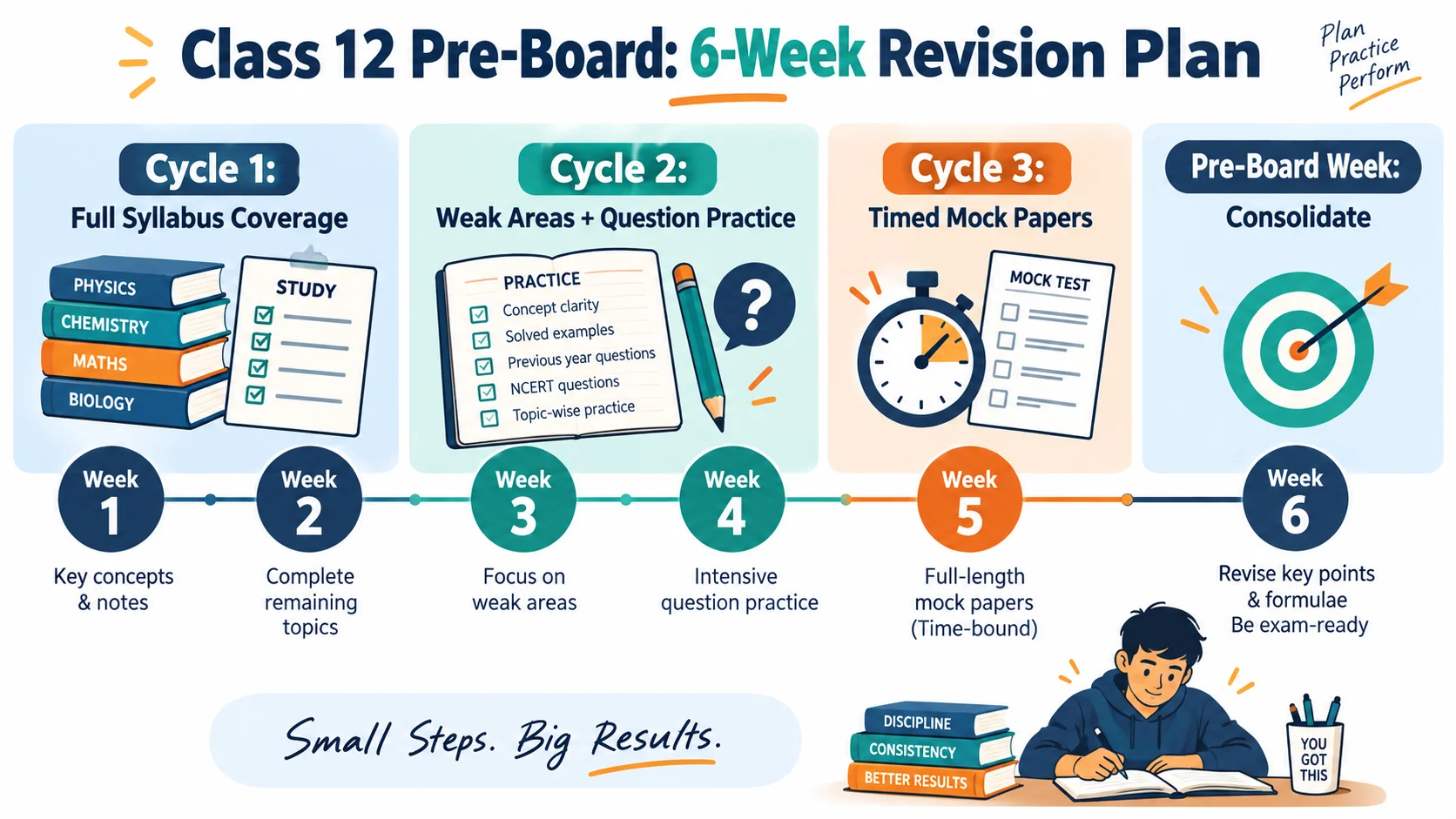
Pre-boards are the closest thing you’ll get to the CBSE Class 12 board exam before February: same syllabus, same paper pattern, same three-hour pressure — but the marks don’t go on your final certificate. That makes them the best dress rehearsal you have, as long as you’ve revised the whole syllabus, not just the chapters finished last.
This guide turns Class 12 pre board exam preparation into a 6-week plan built around three things that actually move your score: chapter weightage, repeated revision cycles, and timed mock papers. If you start in the last week of September or the first week of October, you’ll finish the plan comfortably before most schools begin their pre-board round.
Why a Plan Matters More Than Extra Hours
Most CBSE schools hold pre-boards between late November and January, and board theory exams are expected to begin in February 2027. Check your school’s circular for exact dates. Either way, there’s little room for a second attempt at revision, so the order you revise in matters as much as the hours you put in.
There’s also good news on the paper pattern. CBSE released the Class 12 Sample Question Papers and Marking Schemes for 2026-27 on 21 September 2026, and the question paper design is the same as last session. So what you practise now is exactly what you’ll face in the pre-board and the board exam.
Keep Class 12 NCERT Solutions and Revision Notes open as you work through this plan — you’ll use them in every revision cycle.
Step 0: Build Your Chapter Map Before Week 1
Before you open a single textbook, spend one evening making a chapter map for every subject. It saves you from the most common pre-board mistake: polishing a 5-mark chapter while a 35-mark unit sits untouched.
- List every chapter with its unit weightage. Take the unit-wise marks from the official CBSE curriculum for 2026-27, not from memory or a coaching handout.
- Rate your confidence from 1 to 3. 1 = I can’t solve a basic question, 2 = I can solve most questions but make mistakes, 3 = I can solve a sample-paper question without help.
- Sort by weightage × weakness. High-weightage chapters with a confidence of 1 go to the top of Week 1. High-weightage chapters rated 3 still need revision, but they can wait for Cycle 2.
Here’s how that looks for Class 12 Mathematics, where the 80-mark theory paper is split across six units:
| Unit | Marks (out of 80) | Revision priority |
|---|---|---|
| Calculus | 35 | Week 1 — start here |
| Vectors and 3D Geometry | 14 | Week 1–2 |
| Algebra (Matrices, Determinants) | 10 | Week 2 |
| Relations and Functions | 8 | Week 2 |
| Probability | 8 | Week 2 |
| Linear Programming | 5 | Week 2 — quick win |
Calculus alone is worth more than 40% of the theory paper. Revise it first and you’ve protected a big part of your score before Week 2. Do the same for Physics, Chemistry, Biology, Accountancy or whichever subjects you take.
The 6-Week Class 12 Pre-Board Revision Plan
The plan runs in three revision cycles. Each cycle covers the full syllabus, but faster and more selectively than the one before. You’ll forget part of what you revise in Week 1 — meeting it again in Weeks 3 and 5 is what makes it stick.
Weeks 1–2: Cycle 1 — Full Syllabus Coverage
The goal of the first two weeks is simple: touch every chapter of every subject at least once, starting with the high-weightage, low-confidence ones from your chapter map.
- Read the NCERT chapter, not a guide. Board questions — especially competency-based ones — are built from NCERT text, in-text examples and diagrams.
- Make one-page summary sheets. Formulas, definitions, reactions, derivation steps and diagrams for each chapter on a single page. These become your revision material for Cycles 2 and 3.
- Solve the NCERT exercise questions you got wrong the first time. Skip the ones you already know cold.
- Rotate subjects daily. Two subjects per day, never the same pair two days in a row, so no subject goes untouched for more than three days.
Weeks 3–4: Cycle 2 — Weak Areas and Question Practice
Now that you’ve seen everything once, shift from reading to answering. Re-rate every chapter on your map and give Cycle 2 time mainly to anything still sitting at 1 or 2.
- Solve previous years’ questions chapter by chapter. This shows you how each topic is actually asked — case-based, assertion-reason, or long answer.
- Practise derivations and long answers by writing them. Physics derivations, Biology diagrams and Accountancy formats need to come out of your pen, not just your head.
- Start your error log. Every mistake gets one line: chapter, what went wrong, and the correct approach. By Week 6, this log is the most valuable revision material you own.
Week 5: Cycle 3 — Mock Papers Under Exam Conditions
Week 5 is when the official sample papers come in. Write one full paper per day, timed at exactly three hours, with your phone in another room. Then check it against the official marking scheme — not an answer key from a random website — because the marking scheme shows you which value points and steps carry marks.
If you want a second opinion on long answers, our breakdown of how AI answer checkers compare with CBSE examiner grading explains where AI feedback helps and where it can mislead you.
Week 6: Pre-Board Week — Consolidate, Don’t Cram
The final week is for sharpening, not new material. Revise only from your one-page summary sheets and your error log, do one more timed paper midweek, and keep your sleep schedule steady — CBSE board papers start at 10:30 AM, so train your brain to be sharp at that hour.
Why Revision Cycles Beat One Long Revision
Revising each chapter three times across six weeks follows one of the best-supported findings in learning research. A large review of distributed practice studies found that spacing study sessions apart produces better long-term retention than packing the same amount of study into one block.
Testing yourself works the same way. Students who practise recalling information — by answering questions instead of re-reading — remember significantly more a week later than students who only re-read. That’s why Cycles 2 and 3 are built around questions and mock papers. A review of ten common study techniques rated practice testing and distributed practice as the two most effective — and rated highlighting and re-reading among the least.
A Sample Daily Pre-Board Timetable
This assumes about 4–5 hours of self-study on school days and 8–9 on weekends. Adjust the times, but keep the structure.
- Before school (30–45 minutes): Quick review of yesterday’s summary sheet or formula list. Active recall only.
- After school, Block 1 (90 minutes): Subject A — the harder or higher-weightage subject of the day, while your focus is freshest.
- Break (30 minutes): Food, a walk, no scrolling — our guide on building concentration in the era of Shorts and Reels explains why short-video breaks stretch.
- Block 2 (90 minutes): Subject B — question practice from the chapter you revised earlier in the week.
- Night (30 minutes): Update your error log and plan tomorrow’s two subjects.
For a deeper look at building a routine you can actually stick to, read How to Create a Daily Study Routine That Actually Works.
Your Mock Paper Schedule
Mock papers only help if they’re spaced out and properly reviewed. This schedule leaves time to learn from each one:
| Week | Mock papers | What to focus on |
|---|---|---|
| Weeks 1–2 | None — section-wise practice only | Chapter coverage |
| Weeks 3–4 | 1 half paper per subject (90 minutes) | Speed on objective and short-answer sections |
| Week 5 | 1 full paper per subject, timed | Time management and marking-scheme checking |
| Week 6 | 1 more full paper in your two weakest subjects | Fixing errors from your log |
After every paper, spend at least as long reviewing it as you spent writing it. Mark every lost mark as one of three types — concept gap (didn’t know it), careless error (knew it, got it wrong), or time loss (didn’t reach it). Each needs a different fix.

Subject-Wise Pointers for the Pre-Boards
- Physics: Derivations and numericals carry the bulk of the marks, and both need written practice. Our Class 12 Physics revision strategy goes chapter by chapter, and the Class 12 Physics NCERT Solutions cover every exercise.
- Chemistry: Split your time between Physical (numericals), Inorganic (NCERT lines, almost word for word) and Organic (mechanisms and conversions). If Organic is your weak spot, start with Organic Chemistry Reaction Mechanisms Made Simple.
- Mathematics: Calculus first, always. Practise full step-by-step solutions — CBSE awards step marks, so a correct method with a small arithmetic slip still earns most of the credit. Use the Class 12 Maths NCERT Solutions to check your steps.
- Biology: Labelled diagrams and NCERT terminology score marks. Practise drawing the key diagrams from memory at least twice during Cycle 2, using the Class 12 Biology NCERT Solutions for reference.
- Commerce subjects: Accountancy needs formats practised until automatic; Business Studies and Economics reward case-based application. See Class 12 Economics and Class 12 Business Studies solutions.
If you’re also preparing for CUET, most of your board revision already doubles as domain-subject preparation. Our CUET 2027 guide for Class 12 students shows how the two overlap.
Common Pre-Board Mistakes to Avoid
- Revising in textbook order. Your last chapters end up with the least attention. Revise in weightage order instead.
- Skipping the review after a mock paper. The mistakes are more useful than the score.
- Treating a low pre-board score as a verdict. Pre-board papers are sometimes set tougher than the board paper. Use the result to redirect your January revision, not to panic. Our piece on how AI tutors help students learn from mistakes covers one way to work through the errors you find.

Frequently Asked Questions
Ideally six weeks before your school’s pre-board dates. Most CBSE schools hold pre-boards between late November and January, so starting in late September or early October gives you enough time to complete three full revision cycles.
No. Pre-boards are conducted by your school, and the marks do not appear on your CBSE marksheet. Some schools use them for internal decisions, so take them seriously — but treat them mainly as a full rehearsal for the board exam.
About one full timed paper per subject in Week 5, plus an extra paper in your two weakest subjects in Week 6. Quality matters more than quantity — every paper should be checked against the official CBSE marking scheme and its mistakes added to your error log.
Final Takeaway
A good pre-board score doesn’t come from studying the most hours — it comes from revising in the right order and revising more than once. Map your chapters by weightage, run three revision cycles, practise with timed papers and the official marking scheme, and let your error log tell you where to spend your last week.
Download the planner and trackers above, and keep Class 12 NCERT Solutions and Study Material bookmarked — you’ll be coming back to both all the way through to February.
Leave a Reply