
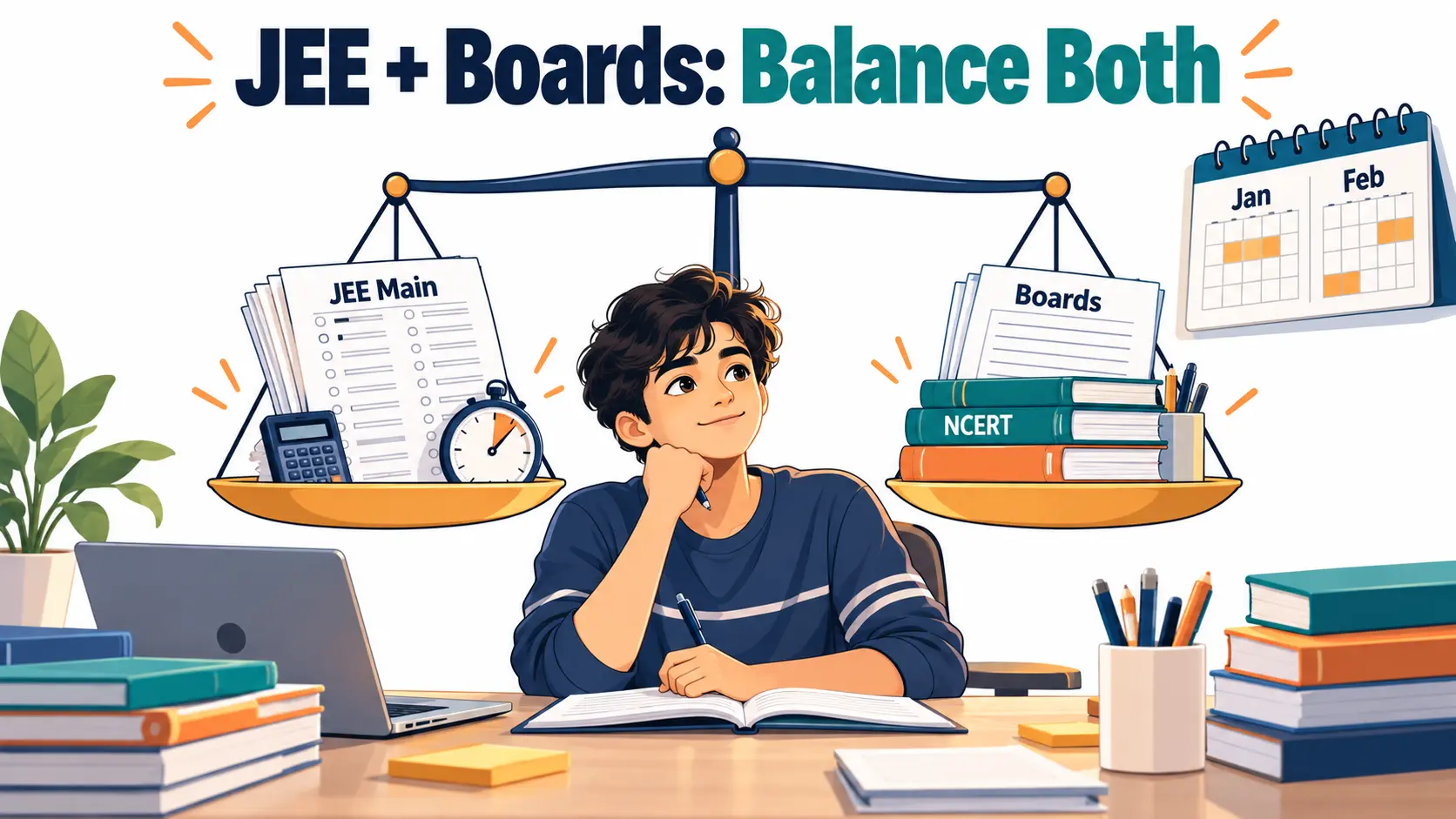
If you’re a Class 12 Science student taking JEE Main 2027, the next six months ask you to run two races at once. JEE Main Session 1 lands in late January, CBSE board theory papers follow from February, and pre-boards sit right before both. Many students respond by studying longer every day, which works for a few weeks and then stops working.
This guide shows you how to balance JEE and board exams without burning out: where the two syllabuses overlap, how to split your week in each phase from now until April, and when to shift your focus fully to boards.
The Calendar You’re Working With
| When | What happens |
|---|---|
| October–November 2026 | School classes finish the syllabus; pre-board preparation |
| December 2026–January 2027 | School pre-boards; practical exams in many schools |
| Late January 2027 | JEE Main Session 1 (reported dates: 22–24 and 28–30 January) |
| February–March 2027 | CBSE Class 12 board theory exams |
| April 2027 | JEE Main Session 2 |
The JEE Main 2027 Session 1 dates above have been widely reported, but NTA had not posted the 2027 information bulletin on the official JEE Main website at the time of writing. Check there before you fix your plan.
Why Board Marks Still Matter for JEE Students
It’s tempting to treat boards as a formality once you’re focused on JEE. That’s risky. For admission to NITs, IIITs and other government-funded technical institutes through JoSAA counselling, you generally need at least 75% in Class 12 (65% for SC/ST candidates) or a place in the top 20 percentile of your board. You can sit JEE Main without it — but a strong JEE rank won’t get you a seat at these institutes if your board marks fall short.
Board marks also matter for your back-up options. If you’re keeping CUET or state counselling open, see our CUET 2027 preparation guide for how board revision feeds into it.
Where JEE and Boards Overlap — and Where They Don’t
| Area | JEE Main | CBSE boards |
|---|---|---|
| Class 12 PCM concepts | Tested | Tested |
| Class 11 PCM | Tested — a large part of the paper | Not tested |
| Question style | MCQs and numericals, speed and accuracy, negative marking | Written answers, derivations, step marks |
| Exact NCERT wording | Less important | Very important (definitions, inorganic chemistry) |
| English and your fifth subject | Not tested | Tested, full marks count |
| Practicals and projects | Not tested | Internal assessment marks |
The working rule: learn each Class 12 chapter once, at JEE depth, then practise writing it the board way. Understanding a concept well enough for JEE problems makes the board questions easier — but board marks also depend on presentation, derivations and NCERT language, which JEE practice won’t train. Our Class 12 Physics revision strategy covers that board-specific layer.
Good examples are electrostatics and integration: both are heavily tested in JEE and carry big board marks, so a single strong pass serves both exams.
How to Study One Chapter for Both Exams
Studying each chapter twice — once for JEE, once for boards — is where most of the extra hours (and the burnout) come from. Instead, run every Class 12 chapter through the same four steps:
- 1. Read the NCERT chapter first. It sets the board syllabus and the language examiners expect, and JEE Main questions are built on the same concepts.
- 2. Solve the NCERT exercises and examples. Check your working with the Physics, Chemistry and Maths NCERT Solutions. This covers most of what boards need.
- 3. Add JEE-level problems. Move on to previous years’ JEE Main questions on the same chapter, timed, to build speed and accuracy.
- 4. Write one board-style answer. Finish with one derivation or long answer written in full, the way the marking scheme expects. It takes ten minutes and keeps your board writing sharp.
Use the chapter tracker in the planner below to tick off each step. A chapter is only “done” when all four are complete.
The Weekly Split, Phase by Phase
There’s no single right ratio for the whole year. The split should change as each exam gets closer. These are starting points — adjust them to your strengths and your school’s pre-board dates.
| Phase | JEE : Boards | Focus |
|---|---|---|
| 1. Now – end of November | 65 : 35 | Finish Class 12 at JEE depth; one board-style written test per subject each week |
| 2. December – pre-boards | 50 : 50 | Pre-boards as full board rehearsal; English and fifth subject get regular slots |
| 3. January, until JEE Session 1 | 80 : 20 | JEE mocks and analysis; keep practical files and board revision ticking over |
| 4. February – March | 10 : 90 | Board exams; only light JEE revision between papers if you’re taking Session 2 |
| 5. After boards – April | 100 : 0 | JEE Main Session 2 |
Phase 1: Now to the End of November
Your main job is to finish Class 12 PCM properly and revise Class 11 for JEE. Once a week, write one board-style test per subject — derivations, long answers, labelled diagrams — so you don’t lose the habit of writing. Give English and your fifth subject at least two short blocks every week; these are easy marks that JEE students often neglect.
Phase 2: December and the Pre-Boards
Treat the pre-boards as a real board rehearsal, not an interruption. Our 6-week pre-board revision plan fits inside this phase if you reduce the JEE share temporarily. A good pre-board result also tells you how much safety margin you have above the 75% line.
Phase 3: January, Until JEE Session 1
This is the one stretch where JEE clearly comes first. Take full-length mocks every few days and spend as long analysing each one as you spent writing it. Keep 20% of your time for boards — mainly practical files and quick revision of board-only material — so February doesn’t start from zero.
Phases 4 and 5: Boards, Then Session 2
Once Session 1 is over, switch to boards almost completely. Use your Session 1 percentile to decide how much Session 2 matters: if you’re happy with it, boards can take all your time; if not, keep a short daily JEE slot for problem practice. After the last board paper, return to JEE for Session 2 — your board revision will have kept the Class 12 concepts fresh, so the focus is Class 11 revision and full mocks.

What a Phase 1 Week Can Look Like
- Monday to Friday, after school: two JEE blocks (one Class 12 chapter, one Class 11 revision topic) and one shorter board block.
- Saturday: one board-style written test (rotate Physics, Chemistry, Maths), plus English or your fifth subject.
- Sunday morning: one full JEE mock under timed conditions.
- Sunday afternoon: mock analysis and next week’s plan. Keep the evening free.
To stay focused inside these blocks, try the approach in our guide to the Pomodoro technique for students vs time blocking. If you’re preparing without coaching, our strategies to crack entrance exams without coaching fill in the JEE side of the week.
Signs You’re Heading for Burnout
- Your mock scores drop for two or three weeks in a row even though you’re studying more.
- You’re sleeping less to “fit everything in”. Sleep is when memory consolidates; cutting it costs more than it saves.
- You dread opening your books, or you’re re-reading the same page without taking it in.
- Headaches, irritability or constant tiredness that don’t go away with a weekend.
If you notice these, cut back rather than push harder: take one lighter half-day a week, protect your sleep, and trim your plan to what you can actually finish. Talk to a parent, teacher or school counsellor if the pressure feels like too much — that’s a sensible step, not a sign of weakness.
When Should You Shift Focus to Boards?
For most students, the clear switch point is the end of JEE Main Session 1. But shift earlier — and give boards a bigger share from December — if any of these apply:
- Your pre-board percentage is close to 75%. The safety margin matters more than a few extra JEE marks.
- English or your fifth subject is weak. These need regular time, and JEE practice won’t help them.
- Your board-style answers keep losing step marks. Writing practice needs weeks, not days.
For quick extra practice on weak chapters in either exam, our guide on how to use AI to make practice questions shows how to generate questions and check the answers.

Frequently Asked Questions
Yes. Most Class 12 PCM chapters are common to both, so learn each chapter once at JEE depth and then practise writing board-style answers. Change your weekly split as each exam gets closer instead of keeping one fixed ratio.
No. You can sit JEE Main without it. The 75% condition (65% for SC/ST), or a place in the top 20 percentile of your board, applies to admission to NITs, IIITs and other government-funded technical institutes through JoSAA.
For most students, after JEE Main Session 1 in late January. Shift earlier if your pre-board score is close to 75%, if English or your fifth subject is weak, or if your written board answers keep losing step marks.
Final Takeaway
Balancing JEE and boards isn’t about studying more hours — it’s about changing the split at the right time. Learn Class 12 once at JEE depth, keep a weekly board-writing habit, give January to JEE and February to boards, and protect your sleep throughout.
Download the planner, roadmap and check-in above, and keep Class 12 NCERT Solutions and Study Material bookmarked for both exams.
Leave a Reply