
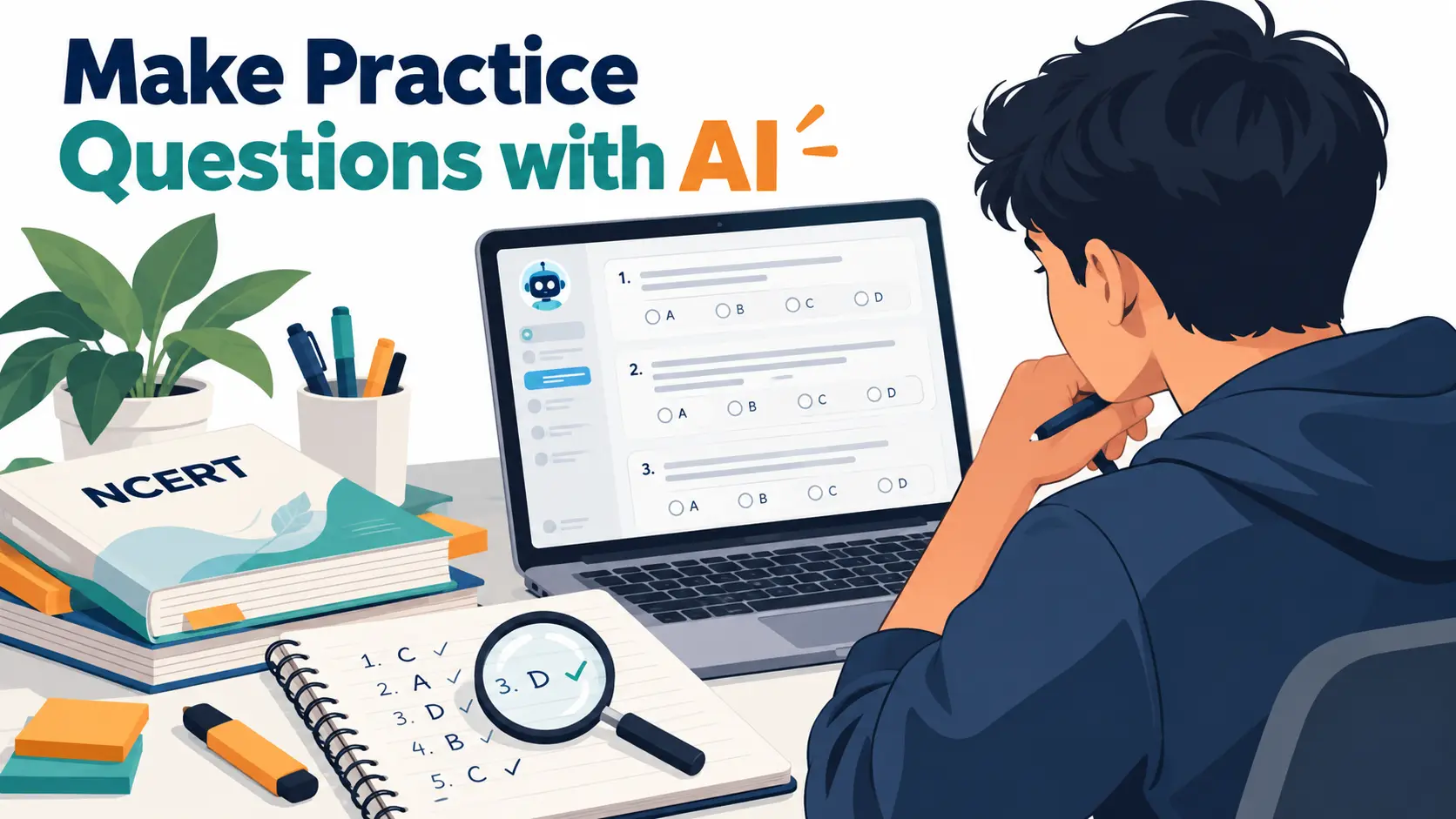
AI chatbots can produce a set of practice questions on any chapter in a few seconds. That’s a real advantage when your textbook has run out of exercises, or your sample paper is already marked. The catch: AI sometimes writes questions with no correct option, gives answer keys that are confidently wrong, or quietly drifts outside the CBSE syllabus.
This guide shows you how to use AI to make practice questions that actually match your board exam, with prompts you can copy, a simple routine for testing yourself, and a checklist for catching the AI’s wrong answers before they cost you marks.
Why Practising With Questions Beats Re-Reading
Answering questions forces you to pull information out of memory, and that effort is what makes it stick. Students who practise recall instead of re-reading remember significantly more a week later. Writing questions helps too: a 2020 study with university students found that generating your own questions on the material improved long-term recall about as much as answering practice questions — and both beat restudying.
AI simply speeds up the question-writing part. The thinking — answering, checking, and fixing your mistakes — still has to be yours. If you’re new to using AI for study, start with our guide on how students can use ChatGPT for concept learning.
Step 1: Give the AI the Right Context
A vague prompt like “give me physics questions” gets you generic questions from no particular syllabus. The more context you give, the closer the questions get to your actual paper. Every good prompt includes five things:
- Board and class: “CBSE Class 12” — not just “Class 12”.
- The exact NCERT chapter and topic: “NCERT Physics Chapter 2, Electrostatic Potential and Capacitance — dielectrics”.
- Question type and marks: MCQ, assertion-reason, 2-mark, 3-mark, case-based or 5-mark.
- Difficulty: “board level”, or a ladder from easy to hard.
- An instruction to hold back the answers: so you attempt the questions before you see the key.
Here’s a base prompt that puts all five together:
You are a CBSE Class 12 examiner. Using only the content of NCERT Physics Chapter 2 (Electrostatic Potential and Capacitance), write 5 board-level MCQs on dielectrics and capacitors. Each MCQ must have exactly one correct option. Do not show the answers yet — I will reply with my answers first.
Step 2: Use Prompts Built for Each Question Type
Assertion-Reason Questions
Write 4 assertion-reason questions in the CBSE format on [chapter/topic], with the four standard options (A) to (D). Hold back the answers until I respond.
Case-Based Questions
Write one CBSE-style case-based question on [topic]: a short real-life passage (80–120 words) followed by 4 linked questions worth 4 marks in total. Use only concepts from the NCERT chapter.
Numericals With Fresh Values
Here is an NCERT example: [paste it]. Write 3 similar numericals that use the same concept but different values and a slightly different unknown. Give answers only when I ask.
A Difficulty Ladder
Write 6 questions on [topic] that get harder step by step: 2 direct recall questions, 2 application questions, and 2 questions that combine this topic with another chapter. Label each level, and hold back the answers.
A ladder shows you exactly where your understanding stops. If you sail through recall but stall at application, that’s the level to practise next — not the whole chapter again.
“Why Is This Option Wrong?”
For each MCQ above, after I answer, explain why every wrong option is wrong, quoting the NCERT idea it contradicts.
This last prompt is the most underused. Understanding why the wrong options are wrong is exactly what helps you in tricky MCQs and assertion-reason questions.
Step 3: Test Yourself the Right Way
- Answer first, on paper. Write your answers — and for numericals, your full working — before you ask for the key.
- Then ask for feedback, not just the key. Paste your answers and ask the AI to point out where your reasoning went wrong.
- Log every mistake. One line per error: topic, what went wrong, and the fix. Our post on how AI tutors help students learn from mistakes explains why patterns across mistakes matter more than any single wrong answer.
- Repeat a few days later. Ask for a new set on the same topic. If you’re following our 6-week pre-board revision plan, AI question sets fit neatly into the question-practice weeks.

A Sample 25-Minute Session
Here’s how one round on a single topic — say, capacitors in series and parallel — might look:
- Minutes 0–3: Paste the base prompt, asking for 5 MCQs and 2 short numericals, answers held back.
- Minutes 3–15: Answer everything on paper, with full working for the numericals. No looking at the textbook.
- Minutes 15–20: Paste your answers, get the key and the explanation for each wrong option.
- Minutes 20–25: Verify any answer that surprised you against NCERT, then log your mistakes — and any mistakes the AI made.
The same routine works for Class 10 students too — swap in your chapter and check answers against the Class 10 NCERT Solutions. Short, focused rounds like this fit easily around school, and they give you far more practice than a single chapter’s exercise questions.
Step 4: Catch the AI’s Wrong Answers
This is the step most students skip — and it’s the one that matters most. AI tools predict likely-sounding text; they don’t check it against your textbook. Treat every AI answer key as a draft until you’ve verified it.
| Red flag | What to do |
|---|---|
| Two options look correct, or none do | Check the concept in the NCERT text. If the question is ambiguous, discard it. |
| A numerical answer doesn’t match yours | Re-solve it yourself, step by step. Then ask the AI to show its working and find where the two differ. |
| A term or topic you don’t recognise | It may be outside the current CBSE syllabus. Check the chapter in your NCERT book before studying it. |
| The answer changes when you ask again | Don’t trust either version. Go back to the textbook or ask your teacher. |
| A definition worded differently from NCERT | Learn the NCERT wording — that’s what the marking scheme expects. |
Two more habits help. First, ask the AI to re-solve its own answer in a fresh chat; a different result is a warning sign. Second, check your topic against the official questions in the CBSE question bank and the Class 12 NCERT Solutions — these have been checked, which AI output hasn’t.
For a worked example, take the formulas from our Class 12 electrostatics notes and use them to check AI-made capacitor numericals. Wrong unit conversions and missing dielectric factors are common AI slips.
Where AI-Made Questions Fall Short
- It doesn’t know the marking scheme. AI can’t tell you exactly which value points earn marks. Our comparison of AI answer checkers and CBSE examiner grading covers this in detail.
- It may use an older syllabus. Topics removed from NCERT books can still appear in AI questions.
- It repeats itself. After a few sets, questions start to look alike. Mix AI questions with sample papers and previous years’ papers.
- Maths needs extra care. Chatbots still make arithmetic and algebra slips. For maths-specific tools, see our roundup of AI tools for solving maths problems.
Use the question log below to track each AI-made set: how you scored and whether the AI’s key held up. Over a few weeks, it shows you which topics — and which AI tools — you can trust. For a wider look at the tools themselves, see our list of the best AI tools for higher secondary students in 2026.

Frequently Asked Questions
Use them as extra practice, not as your main source. Always verify the answer key against your NCERT textbook, and keep solving official sample papers and previous years’ questions alongside them.
Watch for two correct options or none, numerical answers that don’t match your own working, unfamiliar terms, and answers that change when you ask again. Check each against the NCERT text before you trust it.
No. Making and answering practice questions is a study method, not submitted work. It only becomes a problem if you copy AI answers into homework or assignments that are meant to be your own.
Final Takeaway
AI is a fast question writer and an unreliable answer key. Give it precise context, answer on paper before you look, and verify every answer against NCERT. Do that, and you get unlimited practice without learning anything wrong.
Download the prompt pack, verification checklist and question log above, and keep NCERT Solutions and Study Material bookmarked as your source of truth.
Leave a Reply