
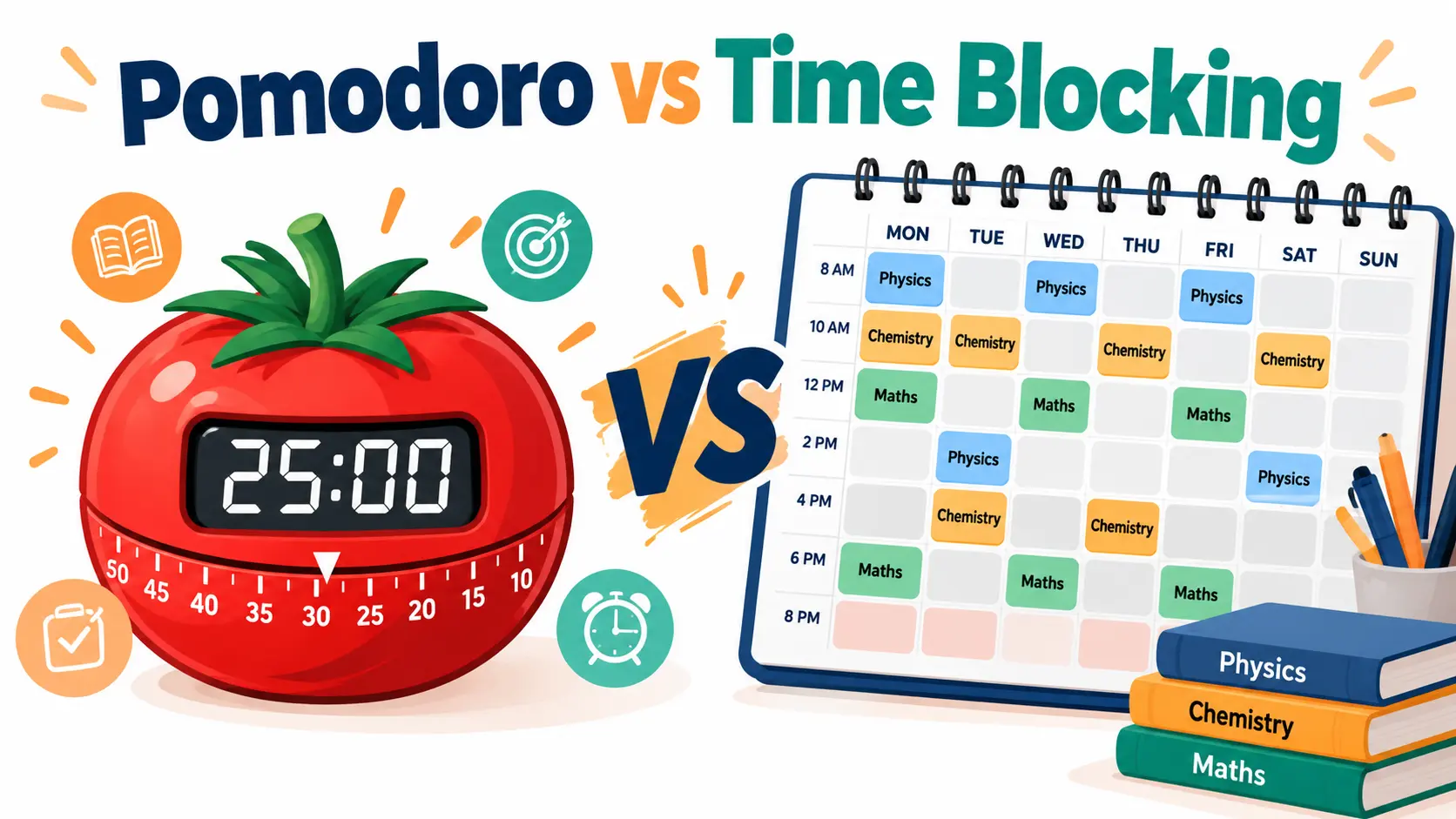
Sit down to study for three hours, and you’ll often find you’ve spent forty minutes on your phone, an hour on one easy chapter, and the rest feeling tired. Two methods promise to fix this: the Pomodoro Technique, which breaks study into short timed sprints, and time blocking, which gives every hour of your day a job. Both are popular, and both get recommended to board exam students — but they solve different problems.
This guide compares the Pomodoro technique for students with time blocking, shows when each one works better during board exam preparation, and gives you a simple way to combine them.
What Is the Pomodoro Technique?
The Pomodoro Technique was developed by Francesco Cirillo in the late 1980s and named after a tomato-shaped kitchen timer. The basic cycle is simple:
- Work for 25 minutes on one task, with no phone and no switching.
- Take a 5-minute break. Stand up, drink water, look away from the screen.
- After four rounds, take a longer break of 15–30 minutes.
There’s research behind the breaks. In a 2023 study of 87 university students, those who took fixed Pomodoro-style breaks reported less fatigue and better concentration and motivation than students who decided their own breaks — and they completed the same amount of work in less time.
What Is Time Blocking?
Time blocking means planning your day in advance by giving each block of time a specific task: “6:00–7:30 pm, Physics: capacitors” instead of “study Physics this evening”. The block is an appointment with a chapter, and you keep it the way you’d keep a tuition class.
It works because it removes the daily decision about what to study. Research on “implementation intentions” — plans that state exactly when and where you’ll do something — found they make people noticeably more likely to follow through than goals alone.
Pomodoro vs Time Blocking: Side by Side
| Pomodoro | Time blocking | |
|---|---|---|
| Main job | Helps you start and stay focused | Decides what you study and when |
| Session length | 25 minutes (adjustable) | Usually 60–120 minutes |
| Best for | Procrastination, hard chapters, short slots on school days | Covering the full syllabus, weekends, long practice papers |
| Planning needed | Very little — just start the timer | Plan the night before or weekly |
| Main risk | Breaks interrupt deep problem-solving | Plans that are too ambitious get abandoned |
| Board exam fit | Daily revision and memorisation | Syllabus coverage and 3-hour mock papers |

When Pomodoro Works Better
- When you can’t get started. “Just 25 minutes” is a much smaller ask than “finish the chapter”. Most of the time, starting is the hard part.
- On a chapter you’re avoiding. Short, timed rounds make a dreaded topic — integration, organic mechanisms, accountancy formats — feel manageable.
- For memorisation and quick revision. Formula lists, definitions and diagrams suit short, intense rounds with a break before the next set.
- When your phone keeps winning. A visible timer makes “just checking” feel like breaking a rule. Our guide on building concentration in the era of Shorts and Reels explains why this matters.
When Time Blocking Works Better
- When the problem is coverage, not focus. If you study every day but some subjects never get a turn, you need a plan, not a timer.
- For long problem-solving. A Physics numerical or a 5-mark Maths question can take longer than 25 minutes. Stopping halfway for a break costs you the thread.
- For mock papers. The board exam is three hours without a break. You can’t practise that in 25-minute pieces.
- On weekends and holidays. With a long, open day ahead, blocks stop the hours from drifting away.
The Best Answer: Use Both
For most board exam students, the strongest system uses time blocking to decide what to study and Pomodoro to decide how to study inside each block. A 90-minute Chemistry block becomes three Pomodoro rounds with short breaks. When a block is for a mock paper or a long problem, you switch the timer off and work straight through.
| Time | Block | How to work inside it |
|---|---|---|
| 5:00–6:30 pm | Maths: integration practice | 3 Pomodoros (25/5) |
| 6:30–7:00 pm | Break | Food, a walk, no scrolling |
| 7:00–8:30 pm | Physics: electrostatics derivations | 2 longer rounds (40/10) |
| 8:30–9:00 pm | Revision | 1 Pomodoro on formulas, then plan tomorrow |
For more on building the day around these blocks, see How to Create a Daily Study Routine That Actually Works. If you’re following our 6-week pre-board revision plan, use one block per subject per day and fill it with rounds.
Building Up to Long Study Sessions
Pomodoro’s one weakness for board students is that the exam itself is a three-hour session. If you only ever work in 25-minute sprints, the real paper can feel exhausting. Build stamina in stages as the exam gets closer:
- Early revision: standard 25/5 rounds.
- A few weeks in: stretch to 50/10 rounds for problem-heavy subjects.
- Pre-board phase: 90-minute blocks with one break, plus a full 3-hour timed paper each week.
Use longer rounds for subjects where you need time to think, like Physics numericals or Class 12 integration problems, and keep short rounds for memory-heavy revision.

Common Mistakes With Both Methods
- Using breaks for your phone. Five minutes of reels rarely stays five minutes. Make breaks physical: stand, stretch, refill your water bottle.
- Planning blocks with no buffer. A schedule packed from 4 pm to 11 pm collapses the first time school runs late. Leave one empty block a day to catch up.
- Writing vague blocks. “Chemistry” is not a plan. “Chemistry: haloalkanes, NCERT exercise 10.1–10.5” is.
- Counting time instead of output. Six Pomodoros of re-reading achieve less than two Pomodoros of answering questions. Our guide on how to use AI to make practice questions gives you quick material for active rounds.
Try It for One Week
Don’t redesign your whole routine at once. For the next seven days, block out just your two hardest subjects each evening and run Pomodoro rounds inside those blocks. Log how many rounds you complete and what you finished. At the end of the week, you’ll know whether the short rounds suit you, whether you need longer ones, and which subjects keep losing their slot. For more ideas on getting more out of the same hours, see our tips on how to study smarter, not longer.
Do You Need a Focus App?
Not really. Your phone’s built-in timer is enough for Pomodoro, and a paper planner or any calendar app is enough for time blocking. Focus apps that lock your phone or grow a virtual tree while you study can help if distraction is your main problem — but check what each app’s free version includes, as features change often.
The bigger risk is spending more time setting up apps than studying. If your phone is the problem, our guide to digital minimalism for students will help more than another app. And if you’re choosing apps for notes as well, see our comparison of the best note-taking apps for CBSE students.
Frequently Asked Questions
Yes, especially for getting started, tackling chapters you are avoiding and quick revision. Combine it with longer sessions closer to the exam, because the board paper itself is three hours long.
Yes. Many students use 50 minutes of study with a 10-minute break for problem-heavy subjects. What matters is a fixed length you decide in advance, followed by a real break.
Use both. Time blocking decides which subject you study and when; Pomodoro helps you stay focused inside each block. Switch the timer off for mock papers and long problems.
Final Takeaway
Pomodoro fixes focus; time blocking fixes planning. Board exam students usually need both — blocks to make sure every subject gets its turn, rounds to stay sharp inside each block, and longer sessions as the exam gets closer.
Download the planner, tracker and self-check above, and keep Revision Notes and Study Material ready so every block starts with the right material.
Leave a Reply