
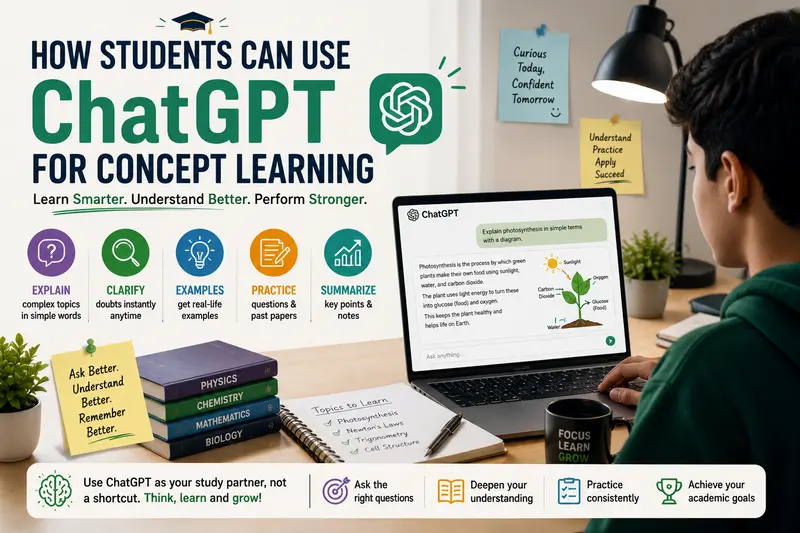
ChatGPT Is Everywhere. But Does It Actually Help You Study?
Last year, a Class 12 student in Pune used ChatGPT to finally understand the Carnot cycle — something her teacher had explained twice and her textbook had described in four dense paragraphs. She typed one question, read the response, asked a follow-up, and within fifteen minutes she got it. She went on to score full marks on that question in her board exam.
That’s the best-case scenario. But plenty of students have also wasted hours on ChatGPT, copy-pasting explanations they never processed, getting wrong answers they didn’t verify, and leaving their NCERT books unopened. Same tool, completely different outcomes.
So the question isn’t really “should I use ChatGPT?” It’s “how do I use it without wasting time or picking up bad habits?” That’s what this article is about. If you’re a higher secondary student preparing for your boards, here’s a grounded look at how to use ChatGPT for concept learning — the right way.
What ChatGPT Actually Is (And Isn’t)
ChatGPT is a text-based AI tool made by OpenAI. You type something, it responds. Simple enough. What makes it different from a Google search is that it doesn’t just throw links at you — it tries to actually explain things, in plain language, in a back-and-forth format.
But here’s what it isn’t: it’s not a CBSE-certified tutor, it doesn’t have your marksheet on file, and it doesn’t know what Ravi Sir explained in class on Thursday. It also makes mistakes — sometimes confident-sounding ones. So treating it like a textbook is a bad idea. Treating it like a smart but fallible study companion? That works much better.
Getting Good Explanations Out of It
The single biggest factor in how useful ChatGPT is for you comes down to how you ask.
Most students open it and type something like “explain photosynthesis” or “what is inertia” — and then wonder why the answer feels too simple or too generic. The thing is, ChatGPT doesn’t know you’re in Class 12 unless you say so. It doesn’t know you’re confused about a specific part of a concept. It just answers what you ask.
So give it more to work with. Compare these two:
What most students type: “Explain the p-block elements.”
What actually gets you somewhere: “I’m a Class 12 CBSE student. I understand the electronic configuration of p-block elements, but I’m confused about why the properties change down the group. Can you explain that specifically, with one or two examples?”
Night and day difference. The second prompt tells it what you already know, what you’re confused about, and the level you’re studying at. You’ll get a response that’s actually targeted to your gap — not a Wikipedia summary of the whole chapter.
Three Ways To Use It That Go Beyond Just Reading Explanations

Let It Re-Explain Things You’re Stuck On
There are topics in Class 11 and 12 that just don’t click the first time — or the third time. Rotational dynamics. Electrochemistry. Probability distributions. The issue isn’t always that you’re not studying hard enough; sometimes the explanation in the textbook just doesn’t match how your brain processes information.
ChatGPT lets you try different angles. You can ask: “Explain entropy using a real-life example, not a textbook definition.” If that doesn’t work, try: “Explain it like I’m 15 and haven’t studied thermodynamics before.” Or: “Show me entropy and enthalpy side by side so I can see the difference.”
This isn’t cheating or avoiding real study. It’s finding the door into a concept that’s been closed to you. Once you get the idea, you still go back to the NCERT and work through it properly.
Use It to Test Yourself, Not Just Explain Things to You
Here’s a shift that makes a real difference. Instead of asking ChatGPT to explain topics to you, ask it to quiz you on them.
Try this prompt after finishing a chapter: “Ask me questions on Chapter 13 of Class 12 Chemistry — Amines. Give me one question at a time and wait for my answer. Tell me whether I’m right and correct any mistakes.”
What you’ve done is turned a passive study session into something closer to a viva. You’re forced to recall information, structure an answer, and confront your own gaps. That’s far more valuable than re-reading notes. Students preparing for boards tend to underestimate how much of their “I know this” feeling is just familiarity — and quizzing yourself with ChatGPT is a quick, uncomfortable way to find out what you actually know.
Ask For The Specific Format You Need
Say you’ve understood a concept but you need to write it in an exam. The language you use matters — CBSE examiners expect precise terminology, and loose paraphrasing loses you marks.
A prompt like “Write a board exam-appropriate answer explaining the principle of superposition of waves, for 3 marks” gives you something to study and compare with your own practice answers. You can also say “Give me a two-line definition of Boyle’s Law as it should appear in a Class 11 board answer.”
This is especially useful in the weeks right before your exams, when you’re shifting from understanding concepts to practising how to express them.
Subject-Specific Uses Worth Knowing
Physics is where a lot of students use ChatGPT most effectively. Derivations are one big area — you can ask ChatGPT to walk through a derivation step by step before you attempt to memorise it, so you understand the logic rather than just the steps. It also helps to describe a problem you got wrong and ask where your approach broke down. For board-level revision strategies alongside this, the best revision approach for Class 12 Physics covers how to structure the remaining weeks effectively.
Chemistry — specifically Organic Chemistry — is another area where conversational explanation genuinely helps. Reaction mechanisms are hard to absorb from diagrams alone. Typing out “walk me through the mechanism of the Cannizzaro reaction and explain why disproportionation happens here” is a different experience from staring at arrows in your textbook. You can ask follow-up questions. You can ask why. That dialogue is what makes things stick.
Maths is trickier. ChatGPT can explain theorems and walk through worked examples clearly, but Maths ultimately requires you to sit with problems and solve them yourself. Use it to understand a concept or check your reasoning — not as a calculator replacement. If it gives you a numerical answer, verify it.
Biology has some of the longest chapters in the CBSE curriculum, and condensing them is genuinely hard. ChatGPT is good at summarising, creating comparison tables (say, comparing mitosis and meiosis across five parameters), and generating short-answer questions from a chapter. These are practical revision tools, especially in the month before exams.
Habits That Quietly Undermine Your Preparation
It’s worth being honest about the ways students use this tool that don’t actually help — because most of them feel like studying even when they aren’t.
Screenshot and save. Many students screenshot ChatGPT’s explanation, add it to their notes folder, and feel like they’ve studied. They haven’t. If you can’t restate the explanation in your own words five minutes later, you haven’t absorbed it. Always close the screen and try to recall.
Using it to avoid hard chapters. Some chapters are avoided precisely because they’re difficult, and ChatGPT makes avoidance easier to justify. “I’ll ask ChatGPT to summarise magnetism for me” is sometimes a way of not doing the actual work. The tool should take you into a topic, not help you skim past it.
Not verifying numbers. This one is important. ChatGPT’s calculation errors are not always obvious. If it gives you a numerical value — for a constant, a formula result, a statistical figure — check it in your textbook before writing it in your notes. This is not a small risk.
One question, exit. The back-and-forth is the point. If a concept isn’t clear after the first response, push further. Ask “why does that happen?” Ask for a different example. Ask what the common misconception about this topic is. A single exchange rarely gets you to actual understanding.
Where to Put It In Your Study Schedule
You don’t need to redesign your day to fit ChatGPT in. A few natural slots work well.
Before you start a new chapter, a five-minute overview helps. Just ask: “Give me a brief overview of Chapter 5 — Magnetism and Matter, Class 12 CBSE. What are the main ideas I should understand?” That mental map makes the first reading of the NCERT feel less overwhelming.
During study, use it only for specific doubts that would otherwise cause you to stop and hunt through multiple resources. Don’t let it become a distraction.
After finishing a chapter, the quiz method works well. Ask it to test you before you move on. It’s a fast way to know whether you need another pass at the chapter or whether you’re ready to move forward.
During revision, ask for comparison tables and concept summaries. “Give me a table comparing NPN and PNP transistors across five parameters” is the kind of thing that’s annoying to make manually and takes thirty seconds to generate. Combine this approach with a broader revision structure — the study strategies built for CBSE board exam preparation are worth reading alongside any AI tool you’re using.
Be Clear About What It Cannot Do
ChatGPT doesn’t know the current CBSE syllabus unless you tell it the chapter and class. It won’t know if a topic was removed this year or if the marking scheme changed. For anything syllabus-related, always confirm with official NCERT or CBSE sources — not AI.
It also cannot replace your teacher for certain things. Personalised feedback on your answer-writing, guidance on which topics carry more marks this year, subject-specific exam strategies — these require a real person who knows the board and knows you. ChatGPT is good at explaining. It’s not good at knowing what you specifically need to fix.
And it has a knowledge cutoff. Anything that changed after its training date won’t be in its responses. For a tool you use daily, that’s a real limitation to keep in mind.
So Should You Be Using It?
If you’re a Class 11 or 12 student, the answer is yes — carefully and with intention.
It’s not going to carry you through your boards. Clearing CBSE exams requires consistent effort with your NCERT textbooks, solving past papers, and working through problems until they feel natural. ChatGPT can’t replace any of that. But for those moments when a concept doesn’t click, when you need a different angle, when you want to test yourself but have no one to quiz you — it’s a genuinely useful resource.
The best way to think of it: a study tool that works well when you’re already working. Not a shortcut, but a supplement. Use it for understanding. Verify what matters. Keep your NCERT open.
Frequently Asked Questions
Q1. Can students use ChatGPT for CBSE board exam preparation?
Yes, and many already do. It’s most useful for understanding difficult concepts, practising definitions in exam-appropriate language, and testing yourself on chapters you’ve finished. The key is to use it alongside your NCERT textbooks, not instead of them. Board questions follow NCERT closely, so that remains your primary source.
Q2. Does using ChatGPT count as cheating?
For personal studying and concept learning — absolutely not. It’s similar to asking a senior student for help or watching an explanation video. You only run into ethical problems if you’re submitting AI-generated content as your own work in an assessment. Using it to understand your syllabus is fair and legitimate.
Q3. Which Class 12 subjects is ChatGPT best for?
Physics, Chemistry (especially Organic), and Biology tend to benefit the most, because these subjects involve understanding processes and logic rather than just memorising facts. For Maths, it’s useful for understanding theorems and checking reasoning, but you still need to put in the problem-solving practice yourself.
Q4. What if ChatGPT gives me the wrong answer?
It happens. Especially with numerical problems and very specific scientific values. Always cross-check anything factual against your NCERT textbook or class notes. A good rule: use ChatGPT to build understanding, and use your textbook to confirm accuracy.
Q5. What’s the most effective way to prompt ChatGPT for studying?
Be specific about your class, board, subject, and what you already understand. A prompt like “I’m a Class 12 CBSE student. I understand the basics of electrochemistry but I’m confused about how EMF is calculated using the Nernst equation. Can you explain it with a simple example?” will give you something far more useful than a broad question.