
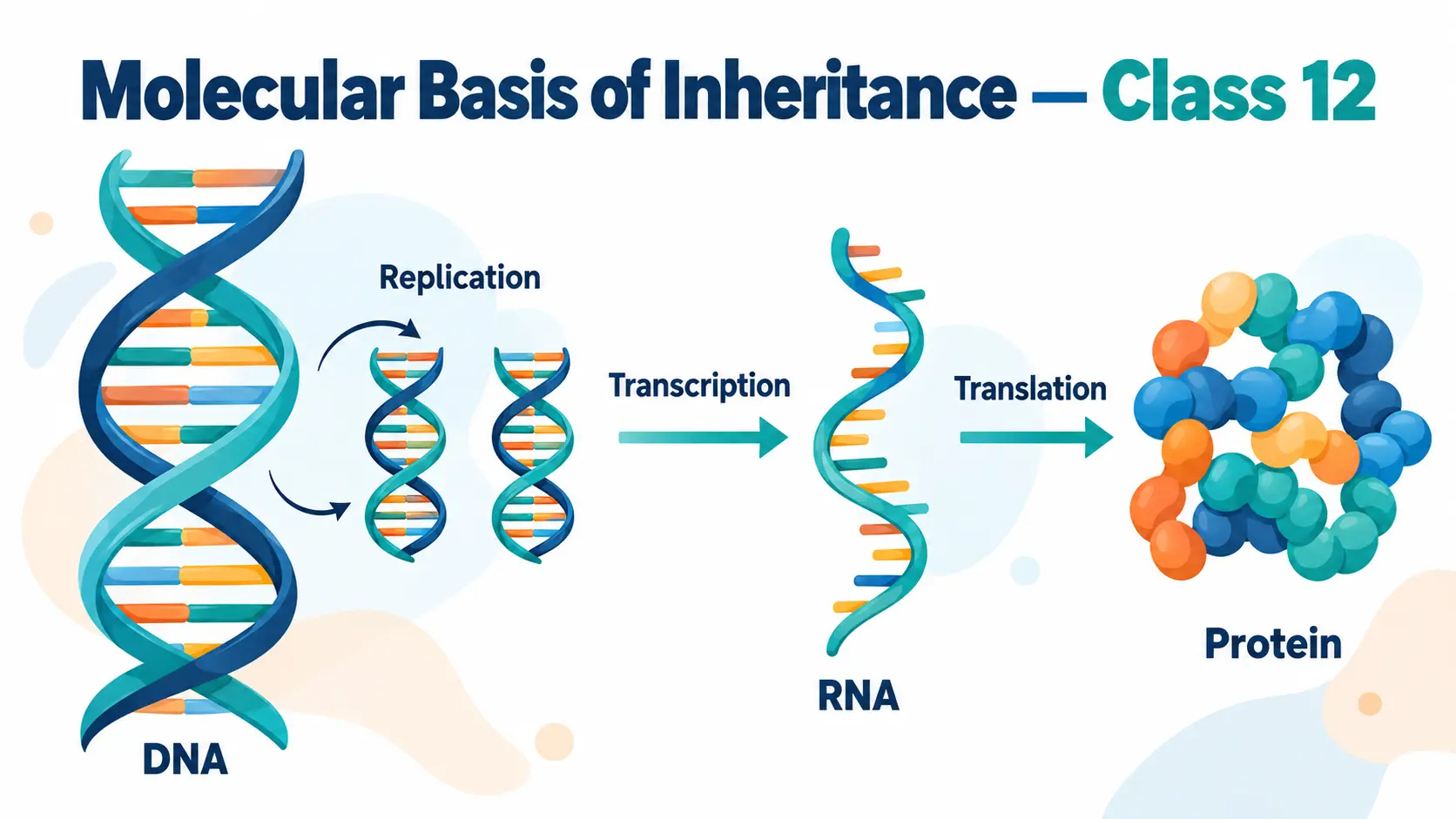
Molecular Basis of Inheritance is the chapter where Class 12 Biology suddenly feels like chemistry. Strands run in opposite directions, enzymes only work one way, and three processes — replication, transcription and translation — sound alike but follow different rules. Most of the confusion comes from mixing those three up.
These molecular basis of inheritance class 12 notes untangle the chapter one process at a time: the structure and packaging of DNA, the experiments that proved DNA is the genetic material, replication, transcription, the genetic code, translation, the lac operon, and the Human Genome Project and DNA fingerprinting — with a comparison table that keeps the three processes separate.
Why This Chapter Matters for Boards and NEET
Molecular Basis of Inheritance belongs to the Genetics and Evolution unit, which carries 20 of the 70 theory marks in the CBSE Class 12 Biology curriculum for 2026-27 — the highest-weighted unit in the paper. It’s also one of the most frequently tested chapters in NEET Biology, and the questions draw almost entirely on NCERT lines and diagrams. One careful pass through this chapter pays off in both exams.
Keep the Class 12 Biology NCERT Solutions open as you go — every section below maps to exercise questions there.
DNA: Structure and Packaging
DNA is a long polymer of deoxyribonucleotides. Each nucleotide has a nitrogenous base, a deoxyribose sugar and a phosphate group. The double-helix model was proposed by Watson and Crick in 1953, drawing on X-ray diffraction data from Maurice Wilkins and Rosalind Franklin.
- Two antiparallel strands: one runs 5′→3′, the other 3′→5′.
- Complementary base pairing: adenine pairs with thymine through two hydrogen bonds; guanine pairs with cytosine through three. This is why, by Chargaff’s rule, A = T and G = C in double-stranded DNA.
- Measurements to remember: the distance between two base pairs is 0.34 nm, and one full turn of the helix has about 10 base pairs (pitch 3.4 nm).
- Packaging in eukaryotes: DNA (negatively charged) wraps around positively charged histone proteins. Eight histones form an octamer, and DNA wrapped around it forms a nucleosome — the “beads-on-string” structure seen under the electron microscope. Loosely packed, active regions are euchromatin; densely packed, inactive regions are heterochromatin.
The Experiments That Proved DNA Is the Genetic Material
| Experiment | What was done | What it showed |
|---|---|---|
| Griffith (1928) | Heat-killed virulent (S) Streptococcus pneumoniae mixed with live non-virulent (R) strain, injected into mice | A “transforming principle” turned R into S |
| Avery, MacLeod and McCarty (1944) | Treated the extract with enzymes that destroy protein, RNA or DNA | Only DNase stopped transformation, so DNA was the transforming principle |
| Hershey and Chase (1952) | Grew bacteriophages with radioactive phosphorus (32P, labels DNA) or sulphur (35S, labels protein) | Only 32P entered bacteria, so DNA — not protein — is the genetic material |
| Meselson and Stahl (1958) | Grew E. coli in 15N, then 14N; separated DNA by density | DNA replicates semi-conservatively |
For each experiment, be ready to explain the method, the result and the conclusion in three short steps — that’s exactly how 3-mark questions are marked.
Why DNA and Not RNA? The RNA World
Evidence suggests RNA was the first genetic material, because it can both store information and act as a catalyst. DNA took over because it is more stable: RNA’s sugar has a reactive 2′-OH group, which makes RNA easier to break down, and DNA’s thymine (in place of uracil) adds further stability. DNA’s two complementary strands also make errors easier to repair. That’s why RNA, which changes faster, suits jobs like carrying messages and catalysing reactions, while DNA is better for long-term storage of genetic information.
DNA Replication
Replication copies the whole DNA molecule before cell division, during the S phase. It is semi-conservative: each new DNA molecule keeps one old strand and gets one new strand. Meselson and Stahl proved this in 1958 — after one generation in 14N, all the DNA had a hybrid density; after two generations, half was hybrid and half was light.
- Starts at the origin of replication, where the strands separate to form a replication fork.
- DNA-dependent DNA polymerase adds nucleotides only in the 5′→3′ direction.
- Leading strand: made continuously. Lagging strand: made discontinuously in short pieces (Okazaki fragments), which DNA ligase joins together.

Transcription: DNA to RNA
Transcription copies one gene’s information from DNA into RNA. Only one strand is used as the template — the strand with 3′→5′ polarity. The other strand, the coding strand, has the same sequence as the RNA (with thymine in place of uracil), which is why gene sequences are written using the coding strand.
- Transcription unit: a promoter (where RNA polymerase binds, upstream of the gene), the structural gene, and a terminator.
- In bacteria: a single RNA polymerase makes all types of RNA. The sigma (σ) factor helps it start; the rho (ρ) factor helps it stop.
- In eukaryotes: three RNA polymerases share the work — RNA polymerase I makes rRNAs (28S, 18S, 5.8S), II makes the precursor of mRNA (hnRNA), and III makes tRNA, 5S rRNA and snRNAs.
- Processing of hnRNA: splicing removes introns and joins exons; capping adds a methyl guanosine triphosphate at the 5′ end; tailing adds a poly-A tail at the 3′ end. The result is mature mRNA.
The Genetic Code
- Triplet: three bases form one codon. There are 64 codons: 61 code for amino acids, and 3 (UAA, UAG, UGA) are stop codons.
- AUG is the start codon and also codes for methionine.
- Unambiguous and specific: one codon codes for only one amino acid.
- Degenerate: some amino acids are coded by more than one codon.
- Read without commas, and nearly universal across organisms.
Translation: RNA to Protein
Translation builds a polypeptide from the mRNA sequence on the ribosome. tRNA is the adapter molecule: one end carries an amino acid, and the other has an anticodon that pairs with the mRNA codon. tRNA looks like a clover leaf in 2D and an inverted L in 3D.
- Charging: each amino acid is first attached to its own tRNA (aminoacylation), using energy from ATP.
- Initiation: the ribosome binds the mRNA at the start codon AUG.
- Elongation: amino acids are joined by peptide bonds as the ribosome moves along the mRNA. In bacteria, the 23S rRNA catalyses this — it acts as a ribozyme.
- Termination: a release factor recognises the stop codon, and the polypeptide is released.
Replication vs Transcription vs Translation
| Replication | Transcription | Translation | |
|---|---|---|---|
| Makes | DNA | RNA | Protein (polypeptide) |
| Template | Both DNA strands | One DNA strand (3′→5′) | mRNA |
| Main enzyme / machine | DNA polymerase, DNA ligase | RNA polymerase | Ribosome, tRNA |
| Scope | Whole genome, once per cell cycle | One gene at a time | One mRNA at a time |
| Where (eukaryotes) | Nucleus | Nucleus | Cytoplasm |
Regulation of Gene Expression: The Lac Operon
The lac operon, described by Jacob and Monod in E. coli, shows how bacteria switch genes on only when needed. It has a regulatory gene (i), which codes for a repressor, and three structural genes: z (β-galactosidase), y (permease) and a (transacetylase).
- No lactose: the repressor binds the operator and blocks RNA polymerase. The structural genes stay switched off.
- Lactose present: lactose acts as the inducer and binds the repressor, which can no longer bind the operator. RNA polymerase transcribes the structural genes, and the enzymes to use lactose are made.
Because the repressor switches the operon off, this is called negative regulation. Practise drawing both states — “off” and “on” — side by side; it’s one of the most frequently asked diagrams in the chapter.

Human Genome Project and DNA Fingerprinting
The Human Genome Project (1990–2003) sequenced the human genome. Its key findings for your notes: the genome has about 3 billion base pairs, less than 2% of it codes for proteins, and 99.9% of the bases are the same in all people. The remaining differences, including single nucleotide polymorphisms (SNPs), are what make individuals unique.
DNA fingerprinting uses those differences. It compares repetitive DNA sequences called VNTRs (variable number tandem repeats), which vary between individuals. The steps are: isolate DNA, cut it with restriction enzymes, separate the fragments by gel electrophoresis, transfer them to a membrane (Southern blotting), hybridise with a labelled VNTR probe, and detect the pattern by autoradiography. It’s used in forensics and paternity testing.
Common Mistakes That Cost Marks
- Mixing up template and coding strands. The template is read; the coding strand matches the RNA.
- Wrong polarity labels. Every strand in your diagram needs 5′ and 3′ marked correctly.
- Saying all three RNA polymerases occur in bacteria. Bacteria have one; eukaryotes have three.
- Calling the lac operon positive regulation. The repressor makes it negative regulation.
How to Revise This Chapter
Read the NCERT chapter line by line first — board and NEET questions often lift its sentences almost word for word. Then draw the key diagrams from memory: DNA double helix, nucleosome, replication fork, transcription unit, tRNA and the lac operon. Finish with a timed set of questions; our guide on how to solve CBSE sample papers shows how to mark them strictly with the marking scheme.
Genetics belongs in the first week of revision because of its weightage — it’s a full block in Cycle 1 of our 6-week pre-board revision plan. For extra MCQs and assertion-reason questions, use the prompts in how to use AI to make practice questions, and check every answer against NCERT. Our Class 12 electrostatics notes follow the same format if you’re revising Physics alongside, and how the CBSE curriculum supports NEET preparation explains why NCERT-first study works for both exams.
Frequently Asked Questions
Because each new DNA molecule keeps one strand from the parent molecule and gets one newly made strand. Meselson and Stahl proved this in 1958 using E. coli grown first in heavy nitrogen and then in normal nitrogen.
The template strand, with 3′ to 5′ polarity, is read by RNA polymerase during transcription. The coding strand has the same sequence as the RNA made, except that it has thymine where RNA has uracil.
Yes. It is one of the most frequently tested chapters in NEET Biology, and the questions are closely based on NCERT text and diagrams, so the same preparation serves both the board exam and NEET.
Final Takeaway
Molecular Basis of Inheritance gets much easier once you keep the three processes apart: replication copies DNA, transcription copies a gene into RNA, and translation turns RNA into protein. Learn the key experiments in method–result–conclusion form, draw the diagrams with correct 5′ and 3′ labels, and you have most of the chapter’s marks covered for both boards and NEET.
Download the revision sheet, diagram practice sheet and self-quiz above, and keep Class 12 NCERT Solutions, Revision Notes and Study Material bookmarked for the rest of the Genetics unit.
Leave a Reply