
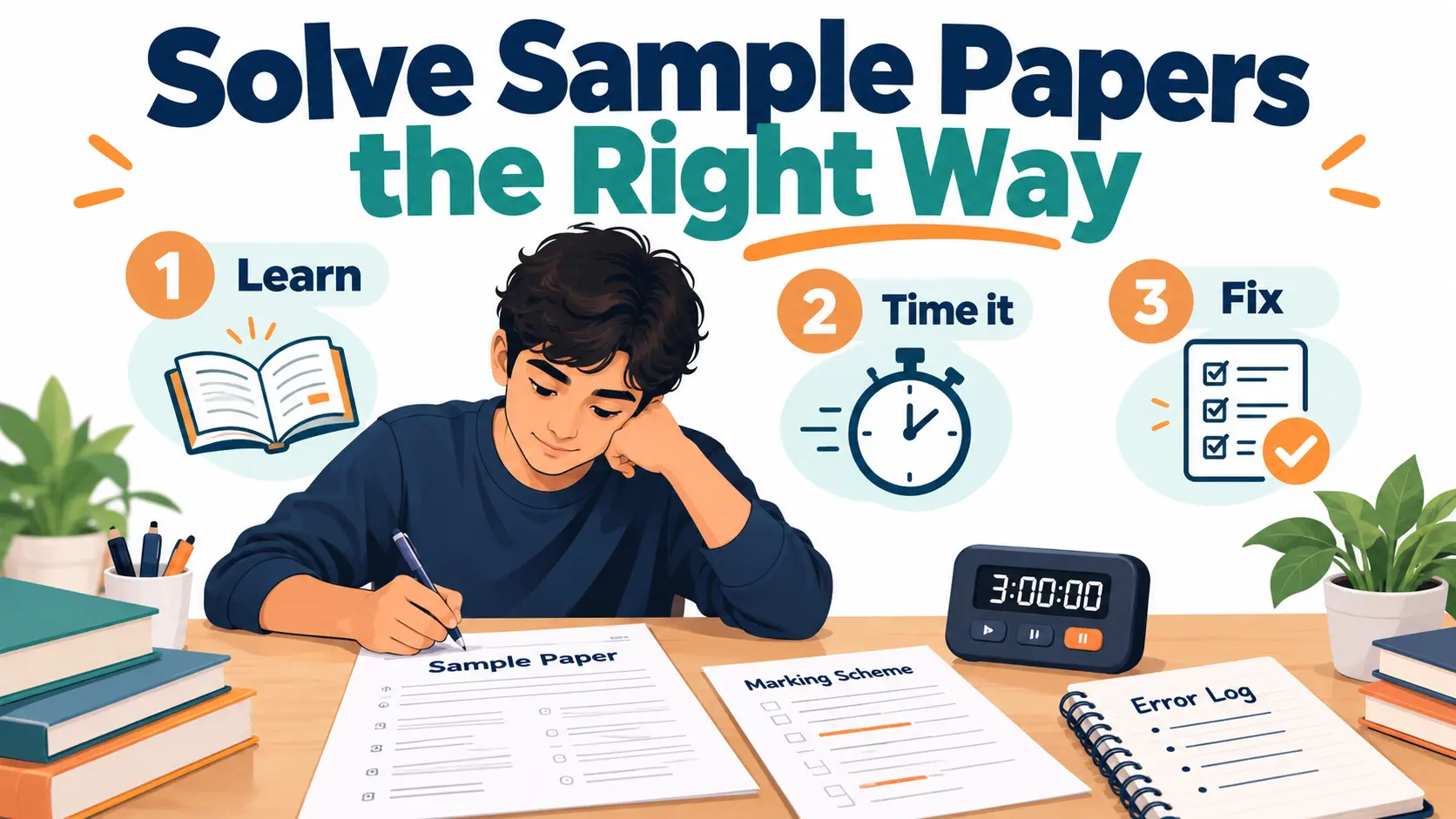
Every year, students download the official CBSE sample papers, solve one or two, glance at the answers, and move on. That uses only a fraction of what these papers can do. A sample paper is the closest thing you have to the real board paper — same pattern, same question types, and an official marking scheme that shows exactly how marks are given.
This guide shows you how to solve CBSE sample papers in three rounds — learn the paper, beat the clock, then fix your mistakes — so each paper raises your score instead of just confirming it.
Why Most Students Waste Sample Papers
- Attempting them too early, before the syllabus is revised, and then having nothing new to practise with later.
- Solving without a timer, so they never find out whether they can finish in three hours.
- Checking only the final answer, instead of the step marks and value points in the marking scheme.
- Never going back to their mistakes, so the same errors turn up again in the pre-boards.
The three-round method fixes all four.
Before You Start: Get the Official Papers
Use the official papers from CBSE, not a copy from a random website. CBSE released the Class 12 Sample Question Papers and Marking Schemes for 2026-27 on 21 September 2026, and the paper design is the same as last session. Class 10 papers are on the same CBSE Academic website. Download both the question paper and the marking scheme for each subject.
You’ll also need a timer, plain A4 sheets (or an old answer booklet), and an error log — a notebook or the tracker below.
Round 1: Learn the Paper (Untimed, Section by Section)
The first attempt isn’t a test — it’s a study session. Solve the paper one section at a time, without a timer, with your NCERT book closed. After each section, check your answers against the marking scheme straight away.
- Notice how questions are framed: case-based passages, assertion-reason options, internal choices.
- Notice what earns marks: the value points in theory answers and the steps in numericals.
- Mark every question you couldn’t answer and note the chapter it came from. That’s your revision list.
Round 1 works best after you’ve revised most of the syllabus once — for many students, that’s during the first two weeks of our 6-week pre-board revision plan.
Round 2: Beat the Clock (Full Timed Attempt)
Now sit the full paper under exam conditions: three hours, phone in another room, no breaks, no looking at notes. Use 15 minutes beforehand to read the paper, as you would in the exam hall.
Go in with a time budget. Here’s one for an 80-mark paper with the CBSE Class 12 Mathematics pattern (38 questions in five sections):
| Section | Questions | Marks | Time budget |
|---|---|---|---|
| A — MCQs and assertion-reason | 20 × 1 mark | 20 | 25 minutes |
| B — very short answer | 5 × 2 marks | 10 | 20 minutes |
| C — short answer | 6 × 3 marks | 18 | 40 minutes |
| D — long answer | 4 × 5 marks | 20 | 50 minutes |
| E — case studies | 3 × 4 marks | 12 | 30 minutes |
| Final check | — | — | 15 minutes |
Write down the actual time you spend on each section. The gap between your budget and reality is one of the most useful things a timed attempt tells you. If three-hour sessions are new to you, build up to them with the stamina steps in our Pomodoro vs time blocking guide.
Self-Evaluation With the Marking Scheme
After a timed attempt, mark your own paper with the official marking scheme — strictly, the way an examiner would. CBSE awards marks step by step: in the 2026-27 Physics marking scheme, a 2-mark question on potential is split into four half-mark steps. So check each step and each value point, not just whether the final answer matches.
- Give a mark only if the point is actually written, not if you “meant” it.
- Check presentation: units, labelled diagrams, formats in Accountancy, the final answer boxed.
- Record two scores: the marks you got, and the marks you lost to careless slips. The second number is the easiest to recover.
AI tools can help you spot missing points, but they don’t know the confidential mark split — our comparison of AI answer checkers and CBSE examiner grading explains when to trust them.

Keep an Error Log
Every lost mark goes into your error log with one line: the question, the chapter, what went wrong and the fix. Sort each error into one of four types, because each needs a different fix:
| Error type | Example | Fix |
|---|---|---|
| Concept gap | Didn’t know how to start | Re-read the NCERT section, then solve 3 fresh questions |
| Careless slip | Sign error, wrong unit, copying mistake | Note the exact slip; check that step in every paper |
| Presentation | Missing diagram, no format, no units | Practise writing that answer type in full |
| Time loss | Didn’t reach the last section | Attempt that section first in the next paper, with a time limit |
Research backs this up: practising recall and reviewing your errors improves long-term retention far more than re-reading.
Round 3: Fix and Re-Attempt
Seven to ten days after Round 2, go back to the same paper. Don’t re-solve all of it — re-attempt only the questions you lost marks on, without looking at your old answers. If you get them right now, the fix has worked. If not, the topic goes back on your revision list.
Then take a fresh paper — a previous year’s board paper — and do a new Round 2. Compare your error log across papers: if careless slips keep falling but time loss doesn’t, your next focus is speed.
Track your scores in the tracker above. A steady rise from paper to paper is the goal — not a perfect score on the first attempt. If a score drops, look at the error log before worrying: one unfamiliar case study or a single time-management slip can explain most of it, and both are fixable before the board exam.
How Many Papers, and When?
| When | What to do |
|---|---|
| October–November | Round 1 on the official sample paper for each subject, once its syllabus is revised |
| December (pre-boards) | Round 2 timed attempts; your pre-boards count as extra Round 2 papers |
| January | Round 3 re-attempts, plus 2–3 previous years’ papers per subject as new Round 2s |
| February | Light review of your error log only — no new full papers in the last days before each exam |
Quality beats quantity. Three papers done properly — attempted, marked strictly and fixed — teach you more than ten papers you only skim. If you’re also preparing for JEE Main, plan your papers around the January session using our guide on how to balance JEE and board exams.
Subject-Specific Tips
- Physics: check derivations step by step against the scheme; our Class 12 electrostatics notes show how sample-paper questions map to topics.
- Maths: differentiate your integration answers to check them — see Class 12 integration techniques, which works through a question from this year’s sample paper.
- Accountancy: mark formats and narrations strictly; the 6-mark admission question in the sample paper follows the steps in our guide to admission of a partner.
When you run out of official papers on a weak chapter, our guide on how to use AI to make practice questions shows how to generate extra ones — and check them.

Frequently Asked Questions
Start once you’ve revised most of a subject’s syllabus at least once, usually October to November for Class 12. Solving them too early leaves you with nothing fresh to practise with closer to the exam.
Do the official sample paper in all three rounds, then two or three previous years’ papers as timed attempts. A few papers done properly, marked strictly and fixed teach more than many papers skimmed.
From the CBSE Academic website (cbseacademic.nic.in), which publishes the Sample Question Papers and Marking Schemes for each subject. The 2026-27 Class 12 papers were released on 21 September 2026.
Final Takeaway
A sample paper is only as useful as what you do after it. Learn the paper in Round 1, beat the clock in Round 2, mark it strictly with the official scheme, log every lost mark, and fix those errors in Round 3. That’s how a few papers turn into real marks in February.
Download the time-budget sheets, tracker and checklist above, and keep Class 12 NCERT Solutions, Revision Notes and Study Material bookmarked for your Round 1 gaps.
Leave a Reply