
Integration is where many Class 12 students start losing confidence in Maths. The rules look simple, but every question seems to need a different trick — and when you can’t spot which one, you’re stuck before you’ve written a line. The good news is that almost every NCERT integral uses one of three methods: substitution, integration by parts, or partial fractions.
This guide covers all three class 12 integration techniques, with a quick way to choose the right method, solved examples in the NCERT style, and the sign errors that cost students the most marks.
Why Integration Matters So Much in the Board Exam
Calculus carries 35 of the 80 theory marks in the CBSE Class 12 Mathematics curriculum for 2026-27 — more than any other unit. Integrals (NCERT Chapter 7) sits at the centre of it, because Application of Integrals and Differential Equations both depend on it.
The 2026-27 Maths sample paper shows how widely it’s spread: an MCQ on an indefinite integral, an assertion-reason question on a definite integral, a 2-mark integral in Section B, and a 5-mark definite integral in Section D — before you even count the area and differential equation questions.
First: How to Choose the Right Method
Before you start writing, spend ten seconds looking at the integrand. These signals point to the right method most of the time:
| What you see | Try this method |
|---|---|
| A function and its derivative together, e.g. etan-1x/(1 + x2) | Substitution |
| A function inside another function, e.g. sin(x2) with an x outside | Substitution |
| A product of two different types of function, e.g. x cos x or x2ex | Integration by parts |
| log x or tan-1x on its own | By parts, taking 1 as the second function |
| ex[f(x) + f′(x)] | Special by-parts result: exf(x) + C |
| A fraction of polynomials whose denominator factorises | Partial fractions |
| A fraction whose numerator’s degree ≥ the denominator’s | Divide first, then partial fractions |
If none of these fits, check whether the integrand matches one of the standard forms in NCERT, like ∫dx/(x2 + a2) or ∫dx/√(a2 − x2), possibly after completing the square.
Method 1: Integration by Substitution
Substitution turns a complicated integral into a simple one by replacing part of it with a new variable, t. It works whenever the derivative of that part is also present (up to a constant). The steps are always the same: choose t, find dt, rewrite everything in t, integrate, and substitute back.
Solved Example: ∫ etan-1x/(1 + x2) dx
- Spot the pair: the derivative of tan-1x is 1/(1 + x2), and it’s sitting right there.
- Substitute: let t = tan-1x, so dt = dx/(1 + x2). The integral becomes ∫ et dt.
- Integrate and substitute back: et + C = etan-1x + C.
Sample Paper Example: ∫ 1/(1 + e2x) dx
This is the 1-mark MCQ in the 2026-27 sample paper, and the substitution isn’t obvious at first. Multiply the numerator and denominator by e-2x to get ∫ e-2x/(e-2x + 1) dx. Now let t = e-2x + 1, so dt = −2e-2x dx, and the integral becomes −½ ∫ dt/t = −½ log(1 + e-2x) + C. Rewriting the log gives x − ½ log(1 + e2x) + C.
Tip for definite integrals: when you substitute, change the limits to t-values too. Then you never need to substitute back — and you avoid one of the most common mark losses in Section D.
Method 2: Integration by Parts
Use integration by parts when the integrand is a product of two functions that substitution can’t simplify. The NCERT formula is:
∫ f(x) g(x) dx = f(x) ∫ g(x) dx − ∫ [f′(x) ∫ g(x) dx] dx
The whole skill is choosing which function is f (the “first” function, which you differentiate). The ILATE order helps: pick whichever comes first in Inverse trigonometric, Logarithmic, Algebraic, Trigonometric, Exponential. It’s a guide, not a law — the right choice is the one that makes the second integral simpler.
Solved Example: ∫ x cos x dx
x is algebraic and cos x is trigonometric, so ILATE makes x the first function. Then ∫ x cos x dx = x sin x − ∫ (1)(sin x) dx = x sin x + cos x + C. Notice the sign: −∫ sin x dx becomes + cos x, because ∫ sin x dx = −cos x.
Solved Example: ∫ log x dx
There’s only one function, so take 1 as the second function: ∫ log x · 1 dx = (log x)(x) − ∫ (1/x)(x) dx = x log x − x + C. The same trick works for ∫ tan-1x dx.
The Shortcut Worth Memorising
∫ ex[f(x) + f′(x)] dx = exf(x) + C. Whenever you see ex multiplied by a function plus its derivative, write the answer directly. For example, ∫ ex(sin x + cos x) dx = ex sin x + C, because the derivative of sin x is cos x.

Method 3: Partial Fractions
Partial fractions split a rational function — a fraction of two polynomials — into simpler fractions you can integrate directly, usually into logs. It only works on a proper fraction, where the numerator’s degree is less than the denominator’s. If it isn’t, divide first.
| Denominator | Write the fraction as |
|---|---|
| (x − a)(x − b) | A/(x − a) + B/(x − b) |
| (x − a)2 | A/(x − a) + B/(x − a)2 |
| (x − a)(x − b)(x − c) | A/(x − a) + B/(x − b) + C/(x − c) |
| (x − a)2(x − b) | A/(x − a) + B/(x − a)2 + C/(x − b) |
| (x − a)(x2 + bx + c), quadratic not factorisable | A/(x − a) + (Bx + C)/(x2 + bx + c) |
Solved Example: ∫ dx/[(x − 1)(x + 2)]
- Set up: 1/[(x − 1)(x + 2)] = A/(x − 1) + B/(x + 2), so 1 = A(x + 2) + B(x − 1).
- Find A and B quickly: put x = 1 to get A = 1/3; put x = −2 to get B = −1/3.
- Integrate: (1/3) log|x − 1| − (1/3) log|x + 2| + C = (1/3) log|(x − 1)/(x + 2)| + C.
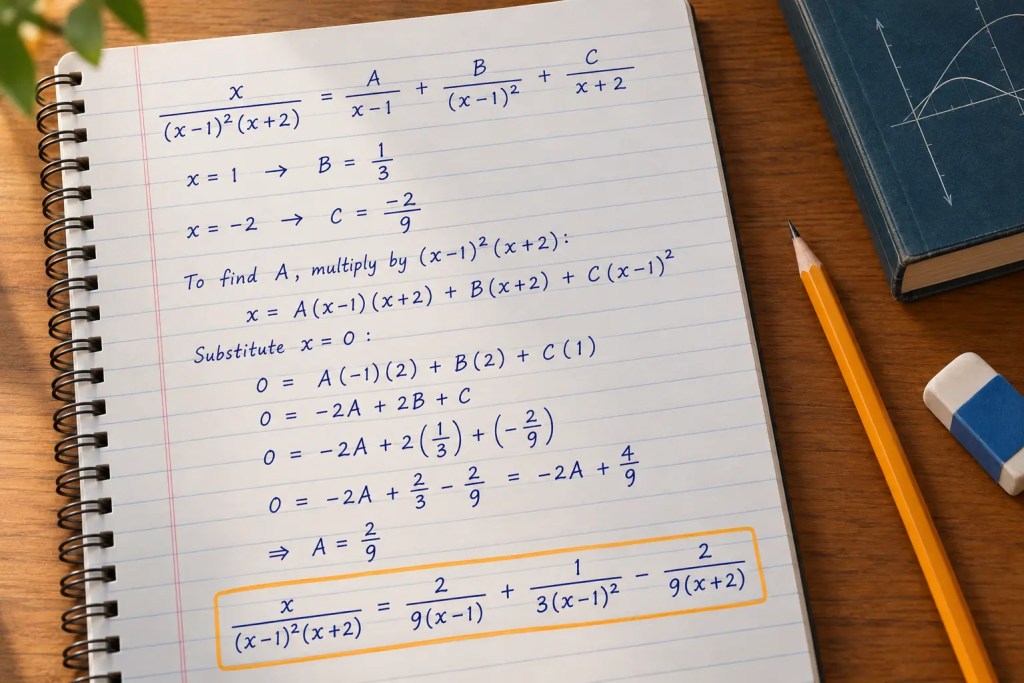
Solved Example With a Repeated Factor: ∫ x dx/[(x − 1)2(x + 2)]
Write x/[(x − 1)2(x + 2)] = A/(x − 1) + B/(x − 1)2 + C/(x + 2), so x = A(x − 1)(x + 2) + B(x + 2) + C(x − 1)2. Putting x = 1 gives B = 1/3, and x = −2 gives C = −2/9. Comparing the coefficients of x2 gives A + C = 0, so A = 2/9. The answer is (2/9) log|(x − 1)/(x + 2)| − 1/[3(x − 1)] + C.
Notice the middle term: B/(x − 1)2 integrates to −B/(x − 1), not to a log. Students who write a log here lose the mark for that step.
Common Sign Errors (and How to Avoid Them)
- ∫ sin x dx = −cos x. This single minus sign causes more lost marks than anything else in the chapter — especially inside integration by parts, where it meets a second minus.
- The minus in the by-parts formula. Put brackets around the whole second integral before you simplify, so the minus applies to every term.
- Missing constants in dt. If t = e-2x + 1, then dt = −2e-2x dx, and the −2 has to be carried through.
- Forgetting the modulus. ∫ dx/x = log|x| + C. Drop the modulus and you may lose a mark.
- Forgetting + C in indefinite integrals, or forgetting to change the limits in definite ones.
The fastest way to check any indefinite integral is to differentiate your answer. If you get back the integrand, you’re right. It takes thirty seconds in the exam and catches almost every sign error.
How to Practise Integration Effectively
- Do a method-choice drill. Take 10 mixed integrals and, without solving them, write which method you’d use. Then check. This trains the skill students struggle with most.
- Solve the NCERT exercises in mixed order. Exercises grouped by method tell you the method in advance; the miscellaneous exercise doesn’t, which is closer to the exam. Check your working against the Class 12 Maths NCERT Solutions.
- Write every step. Step marks matter in Sections B to D. The same step-by-step habit we recommend in Best Techniques to Master Algebra for Class 10 Students applies here.
- Use AI and calculators carefully. Tools can show working for checking, as our roundup of AI tools for solving maths problems explains — but attempt the integral first. If you want more practice questions, our guide on how to use AI to make practice questions shows how to generate them and check the answers.
Track which methods you get wrong in the drill tracker below. With Calculus worth so much, integration belongs in the first week of revision — it’s a full block in Cycle 1 of our 6-week pre-board revision plan. And if you’re also taking Physics, integration turns up in electrostatics derivations such as the potential of a point charge and the energy stored in a capacitor; our Class 12 electrostatics notes show where.
Frequently Asked Questions
Look for signals: a function with its derivative points to substitution, a product of two different types of function points to integration by parts, and a fraction of polynomials with a factorisable denominator points to partial fractions. A method-choice drill on mixed integrals builds this skill fastest.
ILATE stands for Inverse trigonometric, Logarithmic, Algebraic, Trigonometric and Exponential. Choose as the first function whichever comes first in this order. It is a guide: the right choice is whichever makes the remaining integral simpler.
Calculus as a whole carries 35 of the 80 theory marks in the CBSE 2026-27 curriculum. Integrals, Application of Integrals and Differential Equations together make up a large share of that, and integrals appear in every section of the sample paper.
Final Takeaway
Integration stops feeling like a bag of tricks once you see that nearly every question uses one of three methods. Learn the signals for each, practise choosing before solving, and differentiate your answer to check it. That routine alone removes most of the sign errors that cost marks.
Download the cheat sheet, practice worksheet and drill tracker above, and keep Class 12 NCERT Solutions, Revision Notes and Study Material bookmarked for the rest of the Calculus unit.
Leave a Reply