
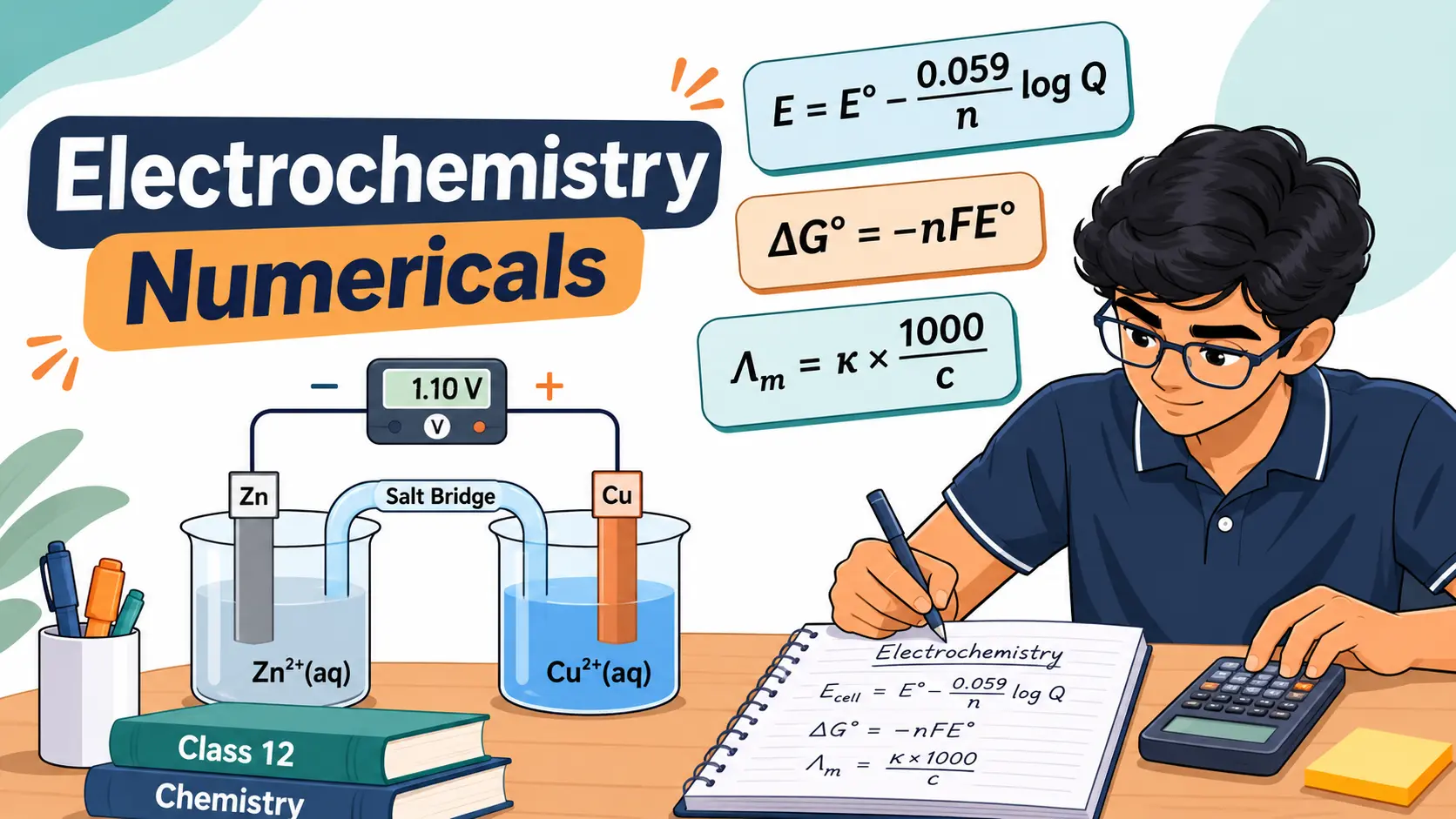
Electrochemistry is the chapter where Class 12 Chemistry turns into maths. The theory is short, but almost every board paper asks you to calculate something: a cell’s EMF, the Gibbs energy of a reaction, a molar conductivity or the mass of metal deposited in electrolysis. Students who know the formulas but haven’t practised the steps lose marks to logs, units and signs.
This guide covers the Class 12 electrochemistry numericals you need for the board exam, one type at a time: what each formula means, a solved example in the NCERT style, and the mistakes that cost marks. Keep your calculator and the Class 12 Chemistry NCERT Solutions beside you as you work through it.
How Much Is Electrochemistry Worth?
In the CBSE Class 12 Chemistry curriculum for 2026-27, Electrochemistry carries 9 of the 70 theory marks, the most of any unit. The syllabus covers electrochemical and galvanic cells, the Nernst equation, conductance of electrolytic solutions, electrolytic cells and electrolysis, batteries, fuel cells and corrosion. The same paper design puts 30% of marks on applying concepts, which in this chapter mostly means numericals.
The Formulas You Need
| Quantity | Formula | Units and notes |
|---|---|---|
| Standard cell potential | E°cell = E°cathode − E°anode | Volts; use reduction potentials for both |
| Nernst equation (298 K) | Ecell = E°cell − (0.059/n) log Q | n = electrons transferred; Q = [products]/[reactants] |
| Gibbs energy | ΔrG° = −nFE°cell | J mol−1; F = 96487 C mol−1 |
| Equilibrium constant | log Kc = nE°cell/0.059 | At 298 K |
| Cell constant | G* = l/A = κR | cm−1 |
| Molar conductivity | Λm = κ × 1000/c | S cm2 mol−1 when κ is in S cm−1 and c in mol L−1 |
| Kohlrausch’s law | Λ°m = ν+λ°+ + ν−λ°− | Limiting molar conductivity |
| Degree of dissociation | α = Λm/Λ°m; Ka = cα2/(1 − α) | Weak electrolytes |
| Faraday’s first law | w = ZIt; Q = It | Moles of electrons = Q/F |
Type 1: Nernst Equation Numericals
The Nernst equation tells you how a cell’s potential changes when concentrations aren’t 1 M. The value 0.059 is 2.303RT/F at 298 K. Write the cell reaction first, then find n and Q from it; most errors come from skipping that step.
Solved Example: EMF of a Daniell Cell
Find the EMF at 298 K of the cell Zn | Zn2+ (0.001 M) || Cu2+ (0.1 M) | Cu, given E°cell = 1.10 V.
- Cell reaction: Zn(s) + Cu2+(aq) → Zn2+(aq) + Cu(s), so n = 2.
- Nernst equation: Ecell = 1.10 − (0.059/2) log ([Zn2+]/[Cu2+]) = 1.10 − 0.0295 log (0.001/0.1).
- Solve: log (10−2) = −2, so Ecell = 1.10 + 0.059 = 1.159 V ≈ 1.16 V.
Sense check: the cathode ion (Cu2+) is more concentrated than the anode ion, which pushes the reaction forward, so Ecell should be higher than E°cell. It is. Solids such as Zn and Cu never appear in Q.
Solved Example: Potential of a Single Electrode
For an electrode reaction Mn+ + ne− → M, the Nernst equation is E = E° − (0.059/n) log (1/[Mn+]). For a copper electrode in 0.01 M Cu2+, with E° = 0.34 V: E = 0.34 − 0.0295 log 100 = 0.34 − 0.059 = 0.281 V. Lower ion concentration means a lower reduction potential, which is worth remembering for assertion-reason questions.
Type 2: Gibbs Energy and Equilibrium Constant
These questions link the cell to thermodynamics. A positive E°cell gives a negative ΔrG°, which means the reaction is spontaneous.
Solved Example: ΔrG° and K for the Daniell Cell
- Gibbs energy: ΔrG° = −nFE°cell = −2 × 96487 C mol−1 × 1.10 V = −212,271 J mol−1 = −212.27 kJ mol−1.
- Equilibrium constant: log Kc = (2 × 1.10)/0.059 = 37.29, so Kc ≈ 1.9 × 1037.
Give ΔrG° in kJ mol−1 with its negative sign; a missing sign is one of the most common half-mark losses. A huge K tells you the reaction goes almost to completion.

Type 3: Conductivity and Molar Conductivity
Conductivity (κ) is the conductance of a solution in a cell of unit length and unit area. Molar conductivity (Λm) divides it by concentration so different solutions can be compared. Conductivity decreases on dilution, because there are fewer ions per unit volume, while molar conductivity increases.
Solved Example: Molar Conductivity of KCl
The conductivity of 0.20 M KCl at 298 K is 0.0248 S cm−1. Then Λm = (0.0248 × 1000)/0.20 = 124 S cm2 mol−1. The factor of 1000 converts mol L−1 to mol cm−3; forgetting it is the classic error in this question.
For cell-constant questions, use G* = κR. If a cell filled with a KCl solution of κ = 0.0129 S cm−1 shows a resistance of 100 Ω, then G* = 0.0129 × 100 = 1.29 cm−1.
Type 4: Kohlrausch’s Law and Degree of Dissociation
For strong electrolytes, Λm rises only slightly on dilution, so Λ°m can be found by extrapolating the graph of Λm against √c to zero concentration. Weak electrolytes like acetic acid don’t give a straight line, so you use Kohlrausch’s law of independent migration of ions instead.
Solved Example: Dissociation Constant of Acetic Acid
The molar conductivity of 0.001028 M acetic acid is 48.15 S cm2 mol−1. Given λ°(H+) = 349.6 and λ°(CH3COO−) = 40.9 S cm2 mol−1, find Ka.
- Kohlrausch: Λ°m = 349.6 + 40.9 = 390.5 S cm2 mol−1.
- Degree of dissociation: α = 48.15/390.5 = 0.1233.
- Dissociation constant: Ka = cα2/(1 − α) = (0.001028 × 0.12332)/(1 − 0.1233) = 1.78 × 10⁻⁵ mol L−1.
Type 5: Electrolysis and Faraday’s Laws
Every electrolysis numerical follows the same path: charge passed, then moles of electrons, then moles of product, then mass or volume. Write the electrode reaction first so you know how many electrons each atom or molecule needs.
Solved Example: Copper Deposited From CuSO4
A current of 2 A is passed through CuSO4 solution for 965 s. The charge is Q = It = 2 × 965 = 1930 C, which is 1930/96500 = 0.02 mol of electrons. Since Cu2+ + 2e− → Cu, that deposits 0.01 mol of copper, or 0.01 × 63.5 = 0.635 g. (Board questions often round F to 96500 C mol−1; use whichever value the question gives.)
For the same charge passed through cells in series, the masses deposited are in the ratio of their equivalent weights (Faraday’s second law).
Batteries, Fuel Cells and Corrosion: The Theory Marks
The last part of the chapter is short theory, usually asked as 1–3 mark questions. Learn the electrode reactions for these:
- Primary batteries: the dry (Leclanché) cell and the mercury cell. The mercury cell gives a nearly constant 1.35 V because no ion whose concentration changes appears in its overall reaction.
- Secondary batteries: the lead storage battery, with its discharge and charging reactions, and the nickel-cadmium cell.
- Fuel cells: the hydrogen-oxygen fuel cell converts the energy of combustion directly into electricity, with water as the product.
- Corrosion: rusting of iron is an electrochemical process in which iron acts as the anode. Painting, galvanising and sacrificial protection all prevent it.

Mistakes That Cost Marks in Electrochemistry
- Writing Q the wrong way round. Products go on top. In the Daniell cell, that’s [Zn2+]/[Cu2+].
- Getting n wrong. Balance the cell reaction first; n is the number of electrons in the balanced equation, not the charge on one ion.
- Subtracting E° the wrong way. Use E°cathode − E°anode with reduction potentials. Don’t flip a sign and then subtract again.
- Dropping the 1000 or the units. Molar conductivity without S cm2 mol−1 loses the final mark.
- Including solids in Q. Pure solids and liquids have activity 1 and are left out.
How to Practise This Chapter
Solve every in-text example and exercise numerical in the NCERT chapter first, then mix types so you learn to recognise them. Write the formula, substitute with units and box the answer, because CBSE marks these step by step. Our guide on how to solve CBSE sample papers shows how to use the official paper and marking scheme to find where you lose marks.
Because it carries the most marks, give Electrochemistry a full block early in Cycle 1 of our 6-week pre-board revision plan. Turning the formula table into flashcards works well too; see our guide to spaced repetition for students. For the organic half of the paper, our organic reaction mechanisms guide pairs well with this one. If you also take Physics, the potential and capacitance ideas in our Class 12 electrostatics notes will feel familiar.
Use the calculator below to check your answers as you practise, and log which types you keep getting wrong.
Frequently Asked Questions
In the CBSE Class 12 Chemistry curriculum for 2026-27, Electrochemistry carries 9 of the 70 theory marks, the highest of any unit.
It is about 0.059 V, which is why the Nernst equation at 298 K is written as E = E° − (0.059/n) log Q.
Molar conductivity is the conductance of all the ions from one mole of electrolyte. On dilution, ions move more freely in strong electrolytes, and weak electrolytes dissociate more, so molar conductivity rises even though conductivity falls.
Final Takeaway
Electrochemistry numericals look varied, but they come from five types: Nernst, Gibbs energy and K, conductivity, Kohlrausch and Faraday. Learn the formula table, write the cell or electrode reaction before you calculate, and keep your units through every step.
Download the formula sheet, practice sheet and calculator above, and use our Revision Notes and Study Material for the rest of the Chemistry syllabus.
Leave a Reply