
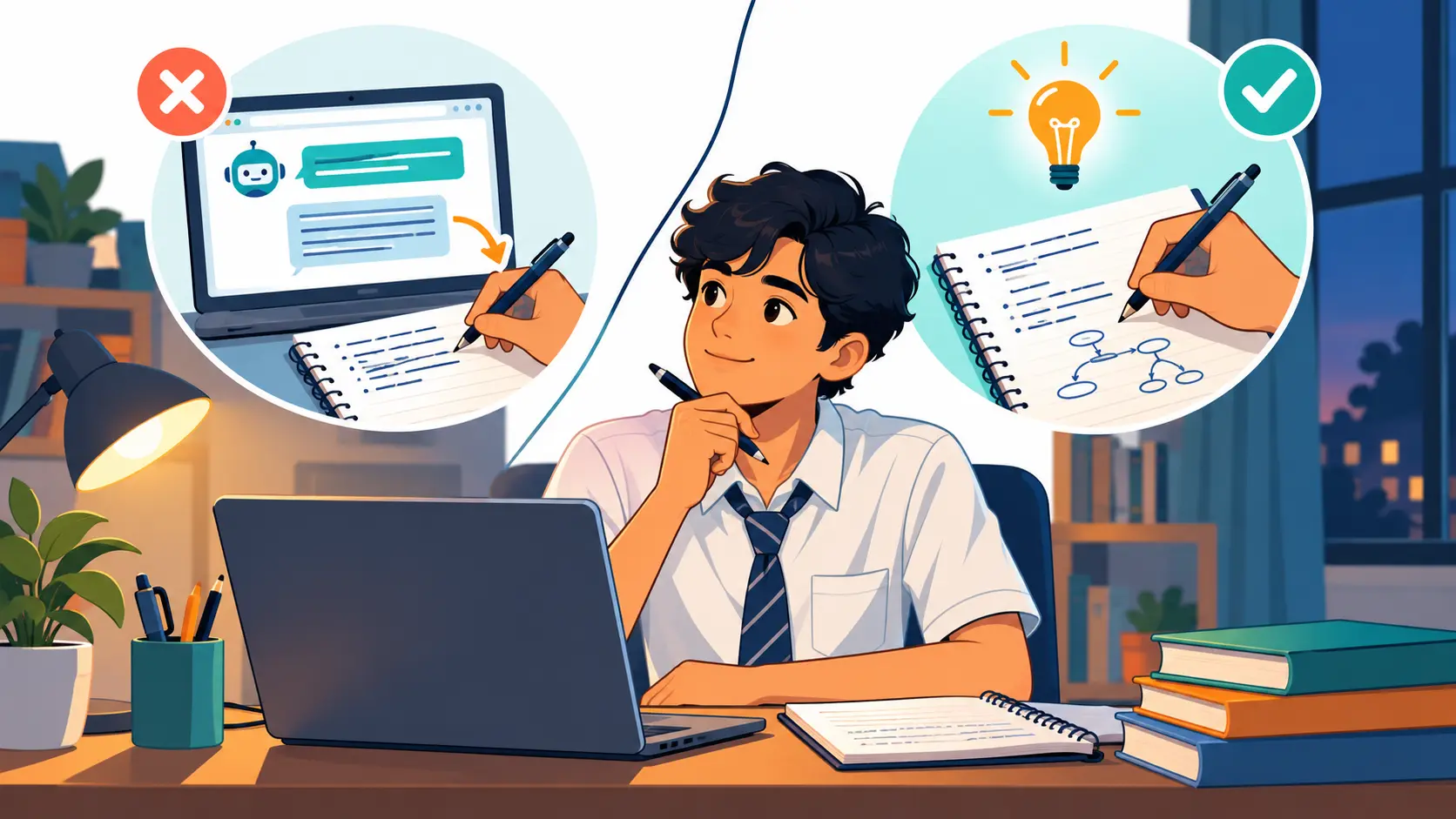
Almost every student has done it, or thought about it: an essay due tomorrow, a stack of maths problems, and ChatGPT sitting one tab away. Type the question, copy the answer, done in two minutes. So is using ChatGPT for homework cheating? Parents worry about it, teachers argue about it, and students mostly guess.
My honest answer is that using ChatGPT for homework is cheating when it does the thinking the homework was meant to make you do — and it isn’t when it helps you think better. The tool is the same in both cases. What changes is who does the work, and whether you’re open about it. Here’s where I’d draw the line, and why it matters more for your marks than you might expect.
The Short Answer: It Depends on What You Hand In
Homework has one job: to make you practise something until you can do it yourself in the exam hall, where there is no AI. If you hand in work that ChatGPT wrote and present it as your own, that is academic dishonesty, in the same way that copying a friend’s notebook always was. It also breaks the main promise of homework, because you skipped the practice.
But a student who asks ChatGPT to explain why a reaction happens, to quiz them on a chapter, or to point out what’s missing from an answer they’ve already written is doing something closer to asking a tutor. Nobody calls that cheating. The difference isn’t whether AI was involved; it’s whether the learning still happened in your head.
What the Research Says About Using AI to Learn vs to Copy
The best evidence I’ve seen comes from a large field experiment with nearly 1,000 high school maths students in Turkey, published in PNAS in 2025. One group practised with a plain GPT-4 chat assistant, another with a version set up as a tutor that gave hints instead of answers, and a third with only textbooks and notes.
During practice, both AI groups did far better than the textbook group. But in the exam that followed, taken without AI, students who had used the plain chatbot scored about 17% worse than the group that never had AI. Many had simply asked for answers. The tutor-style group, which was pushed to work things out, did about as well as the textbook group. As the researchers put it, without guardrails, AI can become a crutch.
That’s the real cost of copying. Getting caught is only part of the risk. The bigger part is walking into the board exam having practised nothing.

Where Students Should Draw the Line
I find it easiest to think in three zones, like a traffic light. Your school’s rules come first, but this works as a default.
| Zone | Examples | Why |
|---|---|---|
| Green: learning | Explaining a concept in simpler words; quizzing you on a chapter; making extra practice questions; checking an answer you’ve already written | You still do the thinking; AI acts like a tutor |
| Amber: ask first | Brainstorming essay ideas; fixing grammar in your own draft; suggesting a structure for a project; translating a source | Allowed by some teachers, not by others; say what you used |
| Red: cheating | Submitting AI-written answers, essays or code as your own; pasting worksheet questions and copying the solutions; using AI in a test | The work isn’t yours, and you skipped the practice |
The amber zone is where most confusion lives. When in doubt, ask your teacher before you start, and write a one-line note at the end of the work saying how you used AI. Being open turns most grey areas into honest ones.
What School Policies Say About AI and Academic Honesty
There’s no single rule that covers every Indian school. Policies vary from school to school and even from teacher to teacher, so read your school’s handbook or circular, and if it says nothing, ask. A few things are clear, though:
- Exams and graded tests are off-limits. Phones and other electronic devices aren’t allowed in board exam halls, and the same goes for school tests.
- Projects and internal assessment must be your own work. Practical files, project reports and assignments count towards your marks, so passing off AI work as yours there is more serious than in daily homework.
- Schools are teaching AI, not just banning it. CBSE is bringing Computational Thinking and AI into Classes 3 to 8 from 2026-27, and its teacher guidelines list “Ethics and Responsible Use of AI” as one of the themes.
- Age limits apply. UNESCO’s guidance on generative AI in education suggests a minimum age of 13 for classroom use, and most AI chatbots set their own age rules, so younger students should use them only with a parent.
A Three-Question Test Before You Use AI
Before you open ChatGPT for a piece of homework, ask yourself:
- 1. Could I explain this answer without the screen? If your teacher asked you to talk through it tomorrow, would you manage?
- 2. Would I be comfortable telling my teacher how I used AI? If you’d want to hide it, that tells you which zone you’re in.
- 3. Is my brain doing the hard part? The hard part is the point of the homework: solving, recalling, arguing, structuring.
Three yeses and you’re almost certainly fine. One no is a reason to stop and rethink.
How to Use ChatGPT to Learn, Not to Copy
The trick is to ask for help with your thinking, not a replacement for it. A few habits that work well:
- Try first, then ask. Attempt the problem on paper, and only then ask AI where you went wrong.
- Ask for hints, not answers. Tell it not to give you the solution, just the next step.
- Make it quiz you. Our guide on how to use AI to make practice questions has ready-made prompts, and shows how to catch the AI’s wrong answers.
- Check it against NCERT. AI makes confident mistakes. Verify facts and solutions with your textbook and the Class 12 NCERT Solutions or Class 10 NCERT Solutions.
Here’s a prompt you can copy that keeps AI in the tutor role:
I'm a CBSE Class [10/12] student working on [topic]. Don't give me the final answer. Ask me one question at a time to help me work it out myself, give a hint only if I'm stuck, and tell me if my reasoning has a mistake.
Keep a simple log of how you use AI for a couple of weeks. You’ll quickly see whether it’s helping you learn or quietly doing your homework for you.

A Note for Parents
Banning AI at home rarely works; your child will meet these tools everywhere. A better approach is to agree on the rules together: which uses are fine, when to ask the teacher, and that tests and graded work stay AI-free. Ask your child to explain their homework to you now and then. If they can, the learning happened. Balance matters too — our guide to digital minimalism for students has practical ideas for screen time at home.
Frequently Asked Questions
It is cheating if you submit AI-written work as your own or let AI do the thinking the homework was set for. Using it to explain concepts, quiz you or check work you’ve already done is usually fine, as long as your school allows it and you’re open about it.
Not always reliably, but teachers often notice when writing doesn’t match a student’s usual style, or when a student can’t explain their own answer. AI detection tools also make mistakes, so the safest approach is honesty about how you used AI.
Yes, if you used it for anything beyond simple spelling checks. A one-line note such as ‘I used ChatGPT to brainstorm ideas and check grammar; the answers are my own’ keeps you honest and lets your teacher guide you.
Final Takeaway
ChatGPT isn’t the problem; outsourcing your thinking is. Use AI the way you’d use a good tutor — to explain, question and check — and never to produce work you hand in as your own. Follow your school’s rules, be open about what you used, and remember that the exam hall has no chatbot. For more ways to study efficiently, see our tips on how to study smarter, not longer, and use CBSE sample papers to test yourself without any help.
Download the honesty checklist, AI use log and family agreement above, and keep our Revision Notes and Study Material handy for checking what AI tells you.
Leave a Reply