
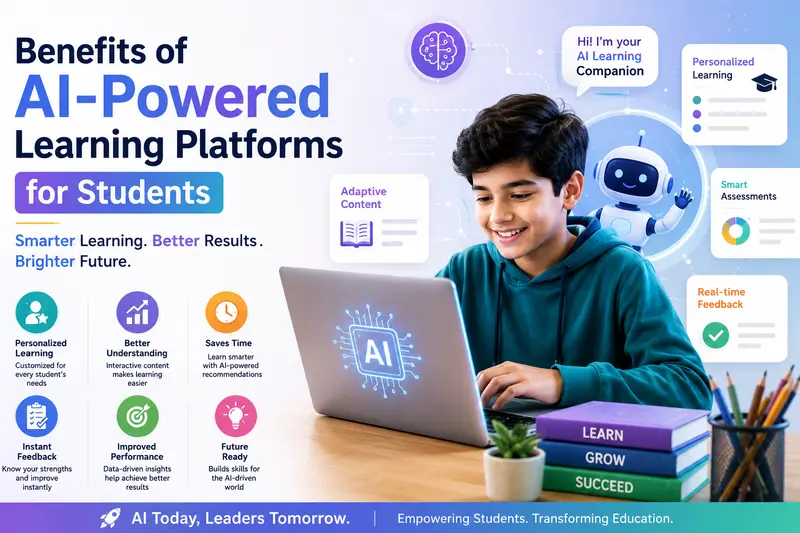
Five years ago, “online learning” basically meant a recorded video of a teacher talking, with maybe a quiz at the end. Useful, but it didn’t really know who was watching. What’s changed is that a platform can now notice — actually notice — that you keep getting the same type of Chemistry question wrong, and start serving you more of exactly that, instead of marching everyone through the same content at the same pace regardless of whether it’s landing.
That’s the real shift behind AI-powered learning platforms. Not some flashy replacement for studying — just a layer that responds to you specifically, instead of treating every student in the batch the same way.
For a student juggling CBSE boards alongside JEE or NEET, that kind of responsiveness genuinely matters. This article gets into what these platforms are actually good at, where they fall short, and how to fold them into a study routine without leaning on them too hard.
What “AI-Powered” Actually Means Here
This phrase gets thrown around loosely, so it’s worth being specific about what it covers.
In practice, an AI-powered learning platform usually does some combination of these things:
- Adjusts difficulty as you go — get a few right, the questions get harder; struggle, and it backs off and gives you more foundational practice
- Points to the specific gap, not just the chapter — instead of “you got 60% on Genetics,” it tells you the actual sub-topic causing trouble
- Paces content differently for different students — moving faster through what you already know, slower through what you don’t
- Gives feedback almost instantly — not just right or wrong, but why, often within seconds of submitting an answer
Testbook, BYJU’s, Khan Academy’s Khanmigo — they all do some version of this, with different strengths. The underlying idea is the same across all of them: less “everyone gets the same worksheet,” more “this is built around what you actually need right now.”
Where These Platforms Genuinely Help

They Find Your Weak Spots Without You Having to Guess
This is probably the single most useful thing about adaptive practice. Working through a question bank top to bottom means doing a lot of questions you didn’t need and skipping past ones you genuinely should have spent more time on — because nothing in a static question bank knows which is which.
An adaptive system does. Get five Electrochemistry questions right, and it pushes you toward harder applications of the same topic. Struggle with Equilibrium, and it keeps circling back to that area until your accuracy actually improves. Your study time goes where it’s needed instead of getting spread evenly across everything, including the stuff you already know cold.
By January, most students preparing for boards don’t have time to spare. Spending it efficiently matters more than it usually gets credit for.
The Feedback Arrives While You Still Remember Making the Mistake
Think about how homework usually works. You solve a problem, hand it in, and the feedback comes back two or three days later — by which point you’ve half-forgotten what you were even thinking when you wrote that answer. The correction doesn’t really land, because the moment it’s correcting has already faded.
AI-powered platforms tend to close that gap to seconds. Get a Maths numerical wrong, and the explanation for why arrives while the problem is still sitting right there in your head. That timing is what makes the correction actually useful — not the explanation itself, necessarily, but the fact that it shows up before you’ve moved on mentally.
This matters a lot in Physics and Chemistry specifically, where understanding why an approach failed is often more valuable than just seeing the right number — and that kind of understanding sticks best when it’s immediate.
It Tells You Which Specific Thing Is Wrong, Not Just That Something Is
A regular test score — “60% on this Biology chapter” — doesn’t actually tell you much. Which part of the chapter? Was it one concept dragging the whole score down, or several smaller gaps?
A good adaptive system can often narrow it down further than that — not “genetics is weak” but specifically “dihybrid cross problems involving independent assortment are where the errors keep happening.” That’s a completely different and far more useful piece of information, because it tells you exactly where to spend the next hour of revision instead of re-reading an entire chapter hoping the right part sinks in.
This solves a problem most students don’t even realise they have: re-revising topics they’ve already nailed (because it feels productive) while the actual weak spot quietly goes untouched.
It’s There at 9 pm When Nobody Else Is
A student stuck on a Physics derivation at night doesn’t have a teacher to ask. That’s just the reality of studying outside school hours. AI-powered platforms are available exactly when the doubt comes up, which sounds minor until you notice how much momentum depends on resolving confusion right away instead of carrying it forward to the next topic, half-understood.
This is one of the more consistently useful things about AI tools built for higher secondary students — not that they’re better than a teacher’s explanation, but that they fill the very specific gap of “I’m stuck right now, and class isn’t until tomorrow.”
You Can Actually See Whether You’re Improving
Most platforms keep a record across weeks and months, not just within one sitting. That makes it possible to check whether a weak area from last month has genuinely gotten better, or whether you’re still making the same mistake despite feeling like you’ve “practised it a lot.”
Trying to track this by memory, across six subjects, over several months, almost never works accurately. People remember the sessions that felt productive, not necessarily the ones that actually moved the needle.
Where They Fall Short — And It’s Worth Knowing This Honestly
It’s easy to oversell what these tools can do, and overestimating them creates real gaps in preparation. A few things worth being upfront about.

They’re much better at some subjects than others. Adaptive systems thrive on clear right-and-wrong answers — Maths, Physics numericals, Chemistry reactions. Ask them to meaningfully grade a History essay or a Political Science analysis, and the feedback gets noticeably vaguer, because judging the quality of an argument isn’t something that automates as cleanly as checking whether a numerical answer matches.
They don’t build the muscle of handwriting under pressure. Boards still require a pen, a clock, and a structured handwritten answer. No amount of instant digital feedback substitutes for the specific discipline of writing a full answer by hand within a time limit. That practice has to happen separately, deliberately, on paper.
Comfort inside the system can be misleading. Getting consistently right answers within an adaptive platform feels reassuring — but it’s not the same as facing an unfamiliar board paper with different phrasing and a different structure. Some systems quietly drift toward question types you’ve gotten comfortable with, which can hide gaps that a genuinely new paper would expose immediately.
One tool rarely does everything well. A platform that’s excellent for working through Maths problems step by step probably isn’t the right place to go for Biology concept revision. Assuming one app covers all your subjects equally well is a common, avoidable mistake.
How To Actually Use These Without Overdoing It

Aim adaptive practice at known weak spots — not your whole syllabus. It’s most useful as a precision tool for fixing specific gaps, sitting alongside a methodical first pass through NCERT, not replacing it.
Follow up digital understanding with something written by hand. If you’ve used a tool to work through a concept — say, the approach described in this piece on using ChatGPT for concept learning — close it afterward and write the explanation or derivation out from memory. Understanding something on a screen and being able to produce it on paper are two different skills, and one doesn’t automatically give you the other.
Actually look at your progress data, honestly. Most platforms show some kind of dashboard. Check it now and then — not obsessively — and ask whether the weak areas flagged a month ago have genuinely improved, or whether the same topics keep resurfacing. If something isn’t budging despite repeated digital practice, that’s a sign to get a teacher’s explanation instead of more automated repetition.
Don’t let the app run your schedule. These platforms are good at spotting gaps. They don’t know your exam date or how much syllabus you’ve actually covered. Your own study plan stays in charge; the platform is a tool you bring in when it’s useful, not the thing deciding what happens next.
What a Realistic Week Might Look Like
For a student balancing boards with JEE or NEET prep, something like this tends to work:
- Daily: A short adaptive session, 20 to 30 minutes, aimed at whatever the platform currently flags as weak
- A couple of times a week: Using an AI tool to clear up something specific from class or NCERT that didn’t make sense the first time
- Weekly: A quick look at the progress dashboard — is anything actually improving, or just feeling more familiar?
- Always, separately: Handwritten, timed practice from NCERT and past papers — this part doesn’t change no matter which digital tools are in the mix
The platforms support all of this. They don’t replace the parts of preparation that specifically need a pen, a clock, and a full-length paper in front of you.
Conclusion
AI-powered learning platforms offer real, practical advantages — adaptive practice that actually targets weaknesses instead of treating every topic the same, feedback fast enough to land before the moment passes, and progress tracking that’s genuinely hard to keep accurately in your own head. For a student stretched across multiple subjects with limited time, that’s not a minor convenience.
What they don’t do is replace the fundamentals: NCERT, handwritten timed practice, and a teacher’s judgment on anything that needs structured written analysis. Used precisely, as one part of a solid routine, they’re genuinely worth having. Used as the entire routine, they leave gaps — and those gaps tend to show up exactly when it matters most.
Frequently Asked Questions (FAQs)
Q1. What are the main benefits of AI-powered learning platforms for CBSE students?
The biggest ones are adaptive practice that goes after actual weak areas instead of treating every topic equally, fast feedback that makes corrections stick because they arrive while the mistake is still fresh, and concept-level diagnosis that points to a specific gap rather than just an overall percentage. Together, these help students use limited study time more efficiently — especially useful in the run-up to board exams.
Q2. Can AI-powered platforms replace traditional studying or tuition?
No, and they’re not really built to. They work best as a supplement, particularly for adaptive practice and quick concept clarification, but they don’t replace handwritten exam practice, a teacher’s judgment on essay-based subjects, or working through NCERT properly. Students who lean on these platforms as their only method tend to discover the gaps under actual exam conditions, which is the worst time to find them.
Q3. Are AI-powered learning platforms equally useful for all subjects?
Not really. They’re strongest where answers are clearly checkable — Maths, Physics numericals, Chemistry problems. For subjects needing structured written analysis, like History or Political Science essays, the feedback tends to be vaguer, since judging an argument’s quality is harder to automate than checking a calculation. Those subjects still lean more on teacher feedback and practice against real marking schemes.
Q4. How can students avoid over-relying on these platforms?
Point adaptive practice specifically at known weak areas rather than letting it replace a full pass through NCERT. Always follow digital concept learning with something written by hand — an explanation or derivation produced from memory, not just read off a screen. And keep your own study plan in the driver’s seat, treating the platform as a tool you use within it, not something that decides your schedule for you.
Q5. Which AI-powered platforms are good for board exam and competitive exam preparation in India?
Testbook and BYJU’s Exam Prep offer adaptive practice suited to both boards and JEE/NEET. Khan Academy’s Khanmigo is solid for guided concept understanding. Most students end up combining a few tools — one for adaptive practice, one for concept explanations, and official CBSE or NCERT resources for anything that needs to be exam-aligned. Rarely does a single platform cover everything equally well.