
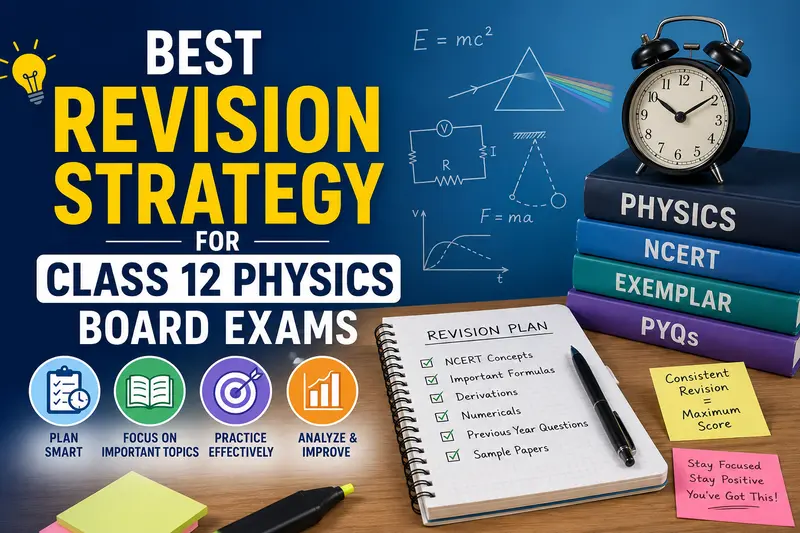
Physics has a reputation among Class 12 students that isn’t entirely fair. Students who struggle with it often describe it as unpredictable — you can study a chapter thoroughly and still find the question paper has come from an angle you didn’t expect. Students who do well in it usually say something different: once you understand the logic of a chapter, the questions start to feel like variations on a few core ideas rather than an endless list of things to memorise.
The difference between those two experiences usually comes down to how revision was done. A solid physics board exam revision strategy isn’t about covering more — it’s about covering the right things in the right way, with enough practice to apply concepts under timed, exam-like conditions.
This article lays out a subject-specific approach for Class 12 Physics revision — one that takes the CBSE syllabus seriously and focuses on what the board actually tests.
Understand The Weightage Before You Open a Chapter

The CBSE Class 12 Physics paper carries 70 marks (theory), with 30 marks from practicals. Before starting revision, know how those 70 marks are distributed.
The broad unit-wise weightage as per the CBSE pattern:
- Electrostatics and Current Electricity — around 16 marks combined
- Magnetic Effects of Current and Electromagnetic Induction — around 17 marks
- Optics — around 18 marks (Ray Optics and Wave Optics together)
- Dual Nature of Radiation, Atoms, and Nuclei — around 12 marks
- Electronic Devices and Communication Systems — around 7 marks
Optics carries the highest weightage of any single cluster. If you’re short on time, that’s not the place to cut corners. Electronic Devices and Communication Systems, on the other hand, are largely factual and can be covered more efficiently.
This isn’t about ignoring any chapter — it’s about making sure your revision time reflects what the paper actually tests.
Build Your Revision Around The NCERT, Not Around Notes
This comes up in every subject but matters especially in Physics, where NCERT problems are directly reflected in board questions year after year.
Every derivation in the NCERT Physics textbook is a potential board question. Not a “similar derivation” — the same one, often with identical or near-identical phrasing. Derivations students regularly lose marks on in Class 12 Physics include:
- Expression for electric field due to a dipole (along axis and equatorial line)
- Derivation of magnetic force on a current-carrying conductor
- Lens maker’s equation
- Expression for motional EMF
- De Broglie wavelength
Go through each derivation and write it out fully — don’t just read through it. The exam asks you to reproduce it step by step, and reading is not the same as being able to write.
Similarly, NCERT in-text questions and exercise problems are worth solving completely, even if they seem straightforward. The board has a consistent pattern of setting questions that are variants of NCERT problems, just with different values or a slight change in what’s being asked.
The Right Class 12 Physics Revision Order
Not all chapters in Class 12 Physics are equally difficult, and not all of them take the same time to revise. Starting with the hardest chapters — especially if you’re revising under time pressure — is usually a mistake. By the time you’ve spent four days struggling through Electromagnetic Induction, you haven’t touched Optics or Modern Physics, and the clock is running.
A more practical sequence:
Start with conceptually clear chapters — Electrostatics fundamentals, Ray Optics, Dual Nature of Radiation. These chapters have well-defined formulas and predictable question types. Revising them early builds momentum and gets marks-heavy topics covered.
Move to the more derivation-heavy chapters — Current Electricity, Magnetic Effects, Electromagnetic Induction. These need more time because derivations need to be written and practised, not just read. Work through NCERT examples alongside these.
End with factual chapters — Atoms, Nuclei, Semiconductors, Communication Systems. These are recall-heavy rather than application-heavy and can be revised effectively closer to the exam when short-term memory is being actively used.
How To Revise Each Type Of Physics Question

Class 12 Physics board questions fall into recognisable types, and each needs a slightly different preparation approach.
Derivations (3–5 marks each)
Write them out. Every time. Not in rough, not mentally — actually write the full derivation, from the starting statement through each step to the conclusion.
If you make a step error during practice, don’t just correct it and move on. Write the entire derivation again cleanly. This trains your hand and your memory simultaneously, which is what the exam actually requires.
Know which derivations are commonly paired with application questions — for instance, Faraday’s Law derivation questions are often followed by a numerical on induced EMF. Preparing them together is more efficient than treating them separately.
Numericals (2–5 marks each)
Numericals in Physics are less about knowing the formula and more about knowing which formula applies to a given situation. Students who memorise formulas without understanding their physical meaning often select the wrong one when a question is worded slightly differently.
Before solving a numerical, write down: what’s given, what’s to be found, which principle applies, and which formula connects them. This process feels slow but it builds a habit that prevents the most common error in board numericals — jumping to a formula before understanding the question.
Practice numericals from NCERT exercises and from CBSE previous year papers. The question types repeat with different values, and recognising the type quickly is a real exam-time advantage.
Short Answer Questions (2–3 marks each)
These are often on definitions, principles, or explanations of physical phenomena — “Why does a compass needle deflect near a current-carrying wire?” or “State and explain Gauss’s Law.”
The key here is precision. Board evaluators follow a marking scheme, and marks are awarded for specific keywords and correct statements. Reading NCERT definitions carefully and learning to reproduce them accurately — not paraphrase them loosely — is what earns full marks on these questions.
Diagrams
Physics diagrams carry dedicated marks in many questions, and they’re one of the most commonly underperformed parts of the paper. A circuit diagram that’s unlabelled, a ray diagram with incorrect normals, or a graph drawn without axis labels can cost you marks you earned by getting the physics right.
Practise diagrams separately. Draw them without looking. Check labelling, arrows, and proportions. The electric field lines around a dipole, the ray diagram for a concave mirror, the energy band diagrams for conductors and semiconductors — all of these come up regularly enough to warrant specific practice.
Use Previous Year Papers — But Use Them Correctly

Previous year CBSE Physics papers are essential for board exam preparation, but most students use them only for practice. They’re also useful for analysis.
After attempting a paper, don’t just check your score. Categorise the questions:
- Which chapters were tested most heavily?
- Which types of questions appeared (derivation, numerical, short answer, long answer)?
- Which questions did you attempt but lose marks on — and why?
Doing this across three to five previous year papers builds a clear picture of where your preparation is solid and where the gaps are. That’s not information you can get from reading through chapters.
For timed practice, attempt papers under actual exam conditions — three hours, no reference material, no checking answers mid-paper. The experience of running out of time on a practice paper, uncomfortable as it is, tells you something important about your exam strategy that comfortable revision cannot.
Common Mistakes That Cost Marks In Physics Board Exams
Not showing units. In every numerical, the unit of the final answer is part of the answer. A calculation that arrives at the correct number but omits the unit loses a mark routinely in Physics boards.
Skipping intermediate steps in derivations. Evaluators award marks for each logical step, not just the final expression. A derivation that jumps from step 2 to step 6 correctly may still lose step marks for everything in between.
Memorising formulas without understanding dimensions. When a student forgets a formula mid-exam, dimensional analysis can often reconstruct it — but only if they understand what the formula represents. Students who memorise without understanding lose this safety net entirely.
Leaving diagrams unlabelled. As mentioned above, this is a consistent source of lost marks. Check every diagram for labels, direction arrows, and accurate representation before moving to the next question.
Spending too long on one question. Physics papers have a significant number of questions and most students feel pressed for time. If a 2-mark question is taking five minutes, it’s worth moving on and returning at the end. One unsolvable numerical shouldn’t cost you three short answer questions.
Practical Section — Don’t Treat It as Secondary
The practical component is 30 marks and is assessed internally. Students sometimes deprioritise it in favour of theory revision, which is a strategic error. Those 30 marks are among the most reliably earnable marks in the entire paper.
Know your experiments. Be able to describe the procedure, the observation table, the formula used, and the sources of error for each experiment in your practical list. Viva questions often revisit NCERT theory connected to the experiment, so reading the relevant theory sections alongside practical preparation is worth doing.
Conclusion
A strong physics board exam revision strategy comes down to three things: knowing where the marks are, practising the right types of questions in the right way, and testing yourself under real exam conditions before the actual paper arrives.
The CBSE Class 12 Physics paper is predictable in its structure — the chapter weightage, the question types, the derivations that appear regularly. Understanding how the CBSE curriculum is built to support systematic learning helps you see why revision that follows the syllabus structure works better than random chapter-hopping. Students who approach it that way consistently find the paper more manageable than those who revise without a plan.
And if you’re reading this closer to the exam than you’d like, the structured approach in last-minute board exam study tips applies here too — focused, prioritised, and calm works better than panicked coverage.
The paper is the same for every student. What differs is the preparation.
Frequently Asked Questions (FAQs)
Q1. How many months before the board exam should I start revising Class 12 Physics?
Ideally, dedicated revision should begin eight to ten weeks before your first board paper. This gives enough time to cover the full syllabus once, do targeted chapter-level practice, and attempt multiple full-length timed papers in the final two to three weeks. Starting revision only in the last two weeks means rushing through chapters that deserve more time — particularly derivation-heavy chapters like Electromagnetic Induction and Current Electricity.
Q2. Which chapters should I prioritise in Class 12 Physics revision?
Based on CBSE weightage, Optics (Ray Optics and Wave Optics combined) carries the most marks and deserves significant revision time. Electrostatics, Current Electricity, Magnetic Effects, and Electromagnetic Induction together make up the bulk of the paper and cannot be skimmed. Dual Nature, Atoms, and Nuclei are moderately weighted and relatively more straightforward. Electronic Devices and Communication Systems are factual and can be covered efficiently in less time.
Q3. How should I practise Physics numericals for the board exam?
Start by attempting NCERT exercise numericals for each chapter — these form the basis of board-level difficulty. Then work through previous year board paper numericals, which follow recognisable patterns. For each numerical, write out what’s given, what’s required, and which formula applies before calculating. This structured approach prevents the most common error: applying the wrong formula because the question was read carelessly under time pressure.
Q4. Are NCERT solutions enough for Class 12 Physics board preparation?
For board exams specifically, NCERT is the foundation and covers the vast majority of what’s tested. Derivations, principles, and definitions from NCERT appear directly in board papers. Reference books are useful for additional numerical practice — particularly for students who want to attempt higher-difficulty problems or who are preparing for JEE alongside boards. But students who haven’t thoroughly worked through NCERT shouldn’t move to reference books first.
Q5. How do I manage time during the Class 12 Physics board exam?
Physics papers are typically three hours for 70 marks. A useful allocation: spend the first 15 minutes reading through the paper and identifying questions you’re confident about. Attempt those first to secure marks quickly. Derivations and long-answer questions typically take 5–8 minutes each — time them during practice so you build a sense of pace. If a numerical isn’t coming together, move on and return rather than letting it consume time needed for other sections.