
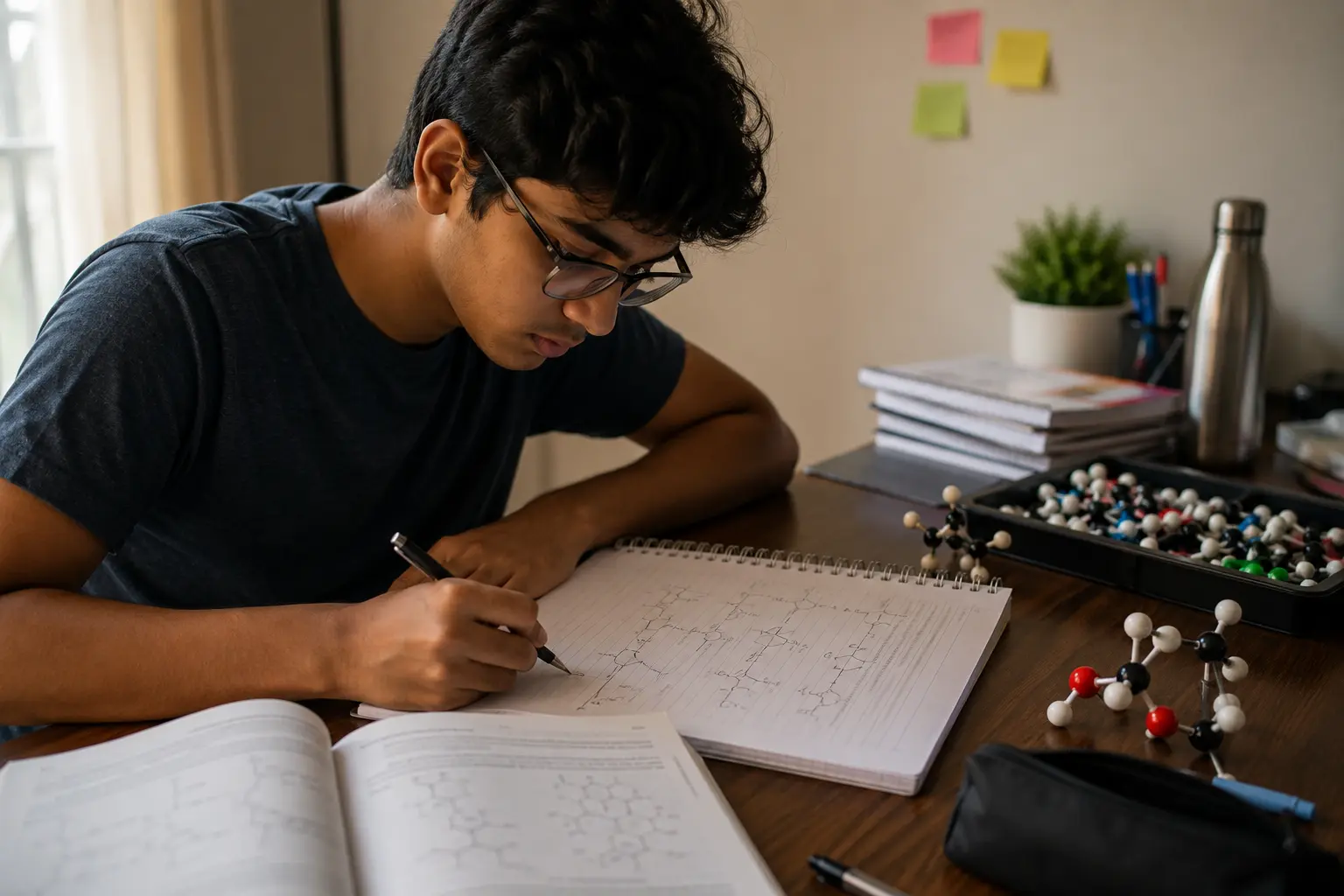
Organic chemistry has a reputation among Class 12 students for being the part of the syllabus where marks either come easily or disappear fast — and it usually comes down to one thing: mechanisms. Once you can actually follow what happens to electrons and atoms, step by step, named reactions stop being a memorization task and start being predictable.
This guide breaks down the mechanisms and named reactions that matter most for Cogniks’ Class 12 Chemistry NCERT Solutions, the way they’re actually tested — not as 40 separate things to memorize, but as two repeating patterns applied again and again.
Why Organic Chemistry Carries So Much Weight
Under the CBSE Class 12 Chemistry syllabus for 2026-27, the theory paper is worth 70 marks, and organic chemistry — spread across four units — accounts for one of the largest shares of that paper: Haloalkanes and Haloarenes, Alcohols/Phenols/Ethers, Aldehydes/Ketones/Carboxylic Acids, and Amines. Aldehydes, Ketones and Carboxylic Acids alone typically carries around 8 marks — the single highest-weighted unit in the entire organic section.
A quick note on the current syllabus: CBSE’s 2026-27 rationalisation removed Polymers and Chemistry in Everyday Life as full chapters, and the nitrogen chapter — now called simply Amines — no longer includes cyanide/isocyanide preparation reactions. Always confirm chapter-level detail against the current NCERT textbook and CBSE’s official curriculum page, since these are revised periodically.
The Only Two Mechanism “Shapes” You Need to Recognize
Despite the long list of named reactions in Class 12 organic chemistry, almost every mechanism you’ll be asked about falls into one of two patterns: substitution or elimination at a saturated carbon (the Haloalkanes and Alcohols chapters), or addition at the carbonyl carbon (the Aldehydes and Ketones chapter). Once these two patterns are second nature, named reactions stop feeling like separate topics and start looking like applications of the same handful of ideas.
Nucleophilic Substitution — SN1 and SN2
- SN1 (unimolecular): happens in two steps. The halide first leaves on its own to form a carbocation (the slow, rate-determining step), and the nucleophile attacks in a second, fast step. Favoured by 3° (tertiary) halides, because a tertiary carbocation is the most stable. Because the carbocation is flat, the nucleophile can attack from either face — this gives racemization.
- SN2 (bimolecular): happens in a single, concerted step — the nucleophile attacks from the opposite side as the leaving group departs. Favoured by 1° (primary) halides, since there’s the least steric crowding for the incoming nucleophile. This backside attack flips the molecule’s configuration, known as Walden inversion.

Elimination — E1 and E2
Elimination reactions (common in alcohol dehydration and haloalkane reactions with a strong base) follow a similar two-vs-one-step logic. E1 goes through the same kind of carbocation intermediate as SN1 and often competes with it. E2 is concerted like SN2, but instead of a nucleophile attacking carbon, a base removes a beta-hydrogen while the leaving group departs at the same time — this needs the hydrogen and leaving group to be anti-periplanar (opposite sides of the molecule).
Nucleophilic Addition — Aldehydes and Ketones
The carbonyl carbon (C=O) is electrophilic because oxygen pulls electron density toward itself. A nucleophile attacks this carbon, the C=O π-bond breaks and pushes electrons onto oxygen (forming an alkoxide intermediate), and protonation gives the final product. It’s the same three-step logic every time, regardless of which nucleophile is involved. This is also why aldehydes react faster than ketones: fewer and smaller alkyl groups around the carbonyl carbon mean less steric hindrance for the incoming nucleophile, and alkyl groups also donate electron density onto the carbon (+I effect), making ketones less electrophilic than aldehydes.

SN1 vs SN2 — How to Tell Them Apart in Seconds
| Feature | SN1 | SN2 |
| Steps | Two (carbocation intermediate) | One (concerted) |
| Best substrate | 3° (tertiary) halides | 1° (primary) halides |
| Stereochemistry | Racemization | Walden inversion |
| Rate depends on | Only the substrate | Substrate and nucleophile |
Named Reactions You Cannot Skip
Most named reactions in Class 12 organic chemistry are just one of the two mechanisms above, applied to a specific molecule. A few worth knowing cold:
- Williamson Ether Synthesis — an SN2 reaction between an alkoxide and a haloalkane, used to make ethers.
- Wurtz Reaction — two haloalkanes coupled with sodium metal to build a symmetrical higher alkane.
- Aldol Condensation — a nucleophilic addition where one carbonyl compound’s enolate attacks another, forming a new carbon-carbon bond.
- Cannizzaro Reaction — a self-redox nucleophilic addition specific to aldehydes with no alpha-hydrogen.
For the complete set — 16 named reactions across all four organic units, with reagents, conditions, and products — use the downloadable cheat sheet below rather than trying to hold all of it in your head at once.
A 3-Step Method for Any Mechanism Question in the Exam
- 1. Identify the functional group and where the “action” happens — is it the carbon holding the leaving group, or the carbonyl carbon?
- 2. Identify the attacking species — a nucleophile or a base, and whether it’s strong/weak, bulky/small.
- 3. Work through it step by step — even a partially correct intermediate structure tends to earn more credit than a guessed final answer.
This kind of structured, repeatable approach isn’t unique to chemistry — the same discipline of breaking a big problem into small, ordered steps is exactly what we cover in Best Techniques to Master Algebra for Class 10 Students and in Best Revision Strategy for Class 12 Physics Board Exams. If one of those approaches clicks for you, it’s worth trying the same habit in the subject you’re reading this for.
Frequently Asked Questions
Rarely as a standalone “draw the mechanism” question — that’s more common in competitive exams like JEE and NEET. CBSE board papers more often test the reasoning behind a mechanism: reactivity-order questions, “why” explanations, and predicting products, all of which rely on the same understanding.
Memorizing gets you through simple recall questions, but understanding the mechanism is what lets you handle unfamiliar substrates or “predict the product” questions CBSE increasingly favours under its competency-based format.
Yes — SN1/SN2/E1/E2 and nucleophilic addition are foundational for JEE and NEET organic chemistry as well, so time spent here carries over directly.
Final Takeaway
Organic chemistry feels overwhelming when every reaction looks like a new thing to memorize. It gets manageable the moment you notice that almost everything traces back to two mechanism patterns — substitution/elimination and nucleophilic addition — applied to different starting materials. Learn the pattern once, and the named reactions become details, not separate subjects.
Keep Class 12 Chemistry NCERT Solutions and Class 12 NCERT Solutions bookmarked, and download both cheat sheets above for quick revision closer to your exams.