
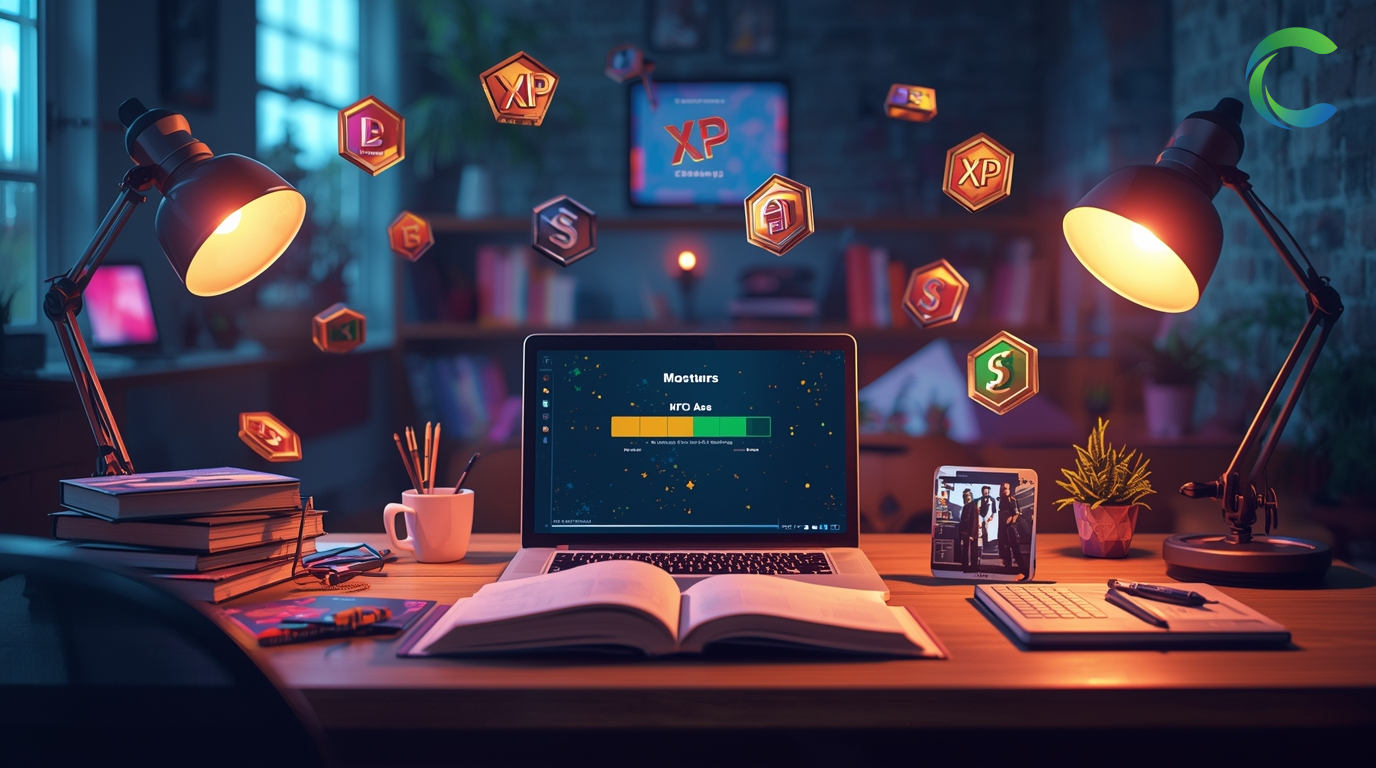
Imagine being eager to learn as you open your NCERT textbook. What if reviewing theory or formulas was more like leveling up in your favorite game than a tedious task? Using game design approaches in education to make Students motivated, focused, and truly like studying is what gamification in learning promises.
Why Gamification Is Important and What It Is?
Fundamentally, gamification In learning is incorporating components into classes such as badges, levels, progress bars, friendly competition, points, and feedback. These same mechanisms that give games their addictive qualities also give academic work structure and ongoing feedback.
There is more to these gaming features than just amusement. They can greatly increase student motivation, enhance knowledge retention, and add fun and interaction to courses. Motivated students frequently perform better on tests and are more involved in their everyday studies, particularly in rigorous courses like NCERT for Class 10 and Class 12.
Principal Advantages of Gamified Education

Here are a few effective ways that gamification can turn mundane learning into an exciting journey.
- Boosts Participation and Engagement: Students feel more invested in the learning process when they can earn badges or watch their name appear higher on a scoreboard. Platforms with gamified elements typically have higher user engagement rates.
- Increases Student Motivation: Game mechanics incentivize effort rather than just output. A sense of accomplishment is produced by finishing tasks, conquering obstacles, and gaining accomplishments. Pupils are driven to resume their studies.
- Enhances Knowledge Retention: Concepts are reinforced through interactive challenges, puzzles, and quizzes that encourage active learning. Students retain more information when they are actively participating.
- Promotes Critical Thinking and Problem Solving: A lot of gamified activities call for planning, judgment, and flexible thinking. Students participate mindfully as opposed to memorizing facts.
- Customizes and Adapts Learning: Games frequently offer many routes, modify difficulty, and provide performance-based feedback. Students can work at their own pace and in accordance with their own learning style thanks to this.
Ways to Use Game Elements in Your Academic Work

To gamify your study, you don’t need complex software or a degree in gaming. You can start a motivated study routine right now with the help of these useful suggestions.
- Clearly define objectives and levels- Divide your syllabus into several levels. For instance, Level 1 corresponds to the fundamentals of NCERT theory, Level 2 to practice questions, and Level 3 to complex issues. Give yourself a prize each time you complete a level. It may be a favorite show, a snack, or a break.
- Make use of progress tracking, badges, and scores- Use apps that display your progress bar or keep a chart. Mark your accomplishments with stars or badges, such as finishing a chapter or doing well on a test. Making progress visually makes you feel good and motivates you to keep going.
- Incorporate Fair Competition- Compete against friends, family, or fellow students. If used properly, a leaderboard can be entertaining. It keeps you energized, promotes student motivation and makes studying feel more like a social activity than a solitary one.
- Give Yourself Something for Your Effort- Don’t rely solely on exam results. Set up little incentives for doing activities and some game elements; for example, you may reward yourself after answering 30 NCERT questions. These incentives increase intrinsic motivation and feed the reinforcement loop.
- Include challenges and quizzes– Make use of timed challenges, question missions, and online tests. Check out free websites or applications that evaluate NCERT content. Challenges provide instant feedback and aid in attentional focus, both of which are essential for progress.
- Monitor Errors and Make Adjustments-“Try again” choices are frequently included in game design because failure isn’t the end. When you make a mistake on a quiz, take note of the mistake, go over the material again, and try again. This develops confidence and leads to mastery over time.
Case Studies & Examples from the Real World
- Gamification In learning is being used by EdTech platforms and schools around the world to revolutionize classrooms. These days, many NCERT-focused portals include interactive quizzes, streaks, and digital badges.
- Gamified learning frequently results in quantifiable benefits, such as improved exam scores, more consistent study habits, and a deeper comprehension of weak areas, according to an analysis of educational resources. When learning through game-like modules, students retain material better and are more engaged.
Things to Remember & Typical Mistakes
Gamification has several benefits, but it must be applied carefully:
- Steer clear of placing too much focus on rewards alone. If rewards take precedence over learning, motivation may suffer.
- Balanced Competition: Excessive comparison, such as consistently placing poorly on a scoreboard, might demotivate certain pupils.
- Maintain Fairness: Students differ in their access to resources and speeds. Gamified Learning need to take inclusion and diversity into account.
In conclusion
Gamification in Learning is not simply a fad; it is a powerful tool for increasing student engagement, motivation, and enjoyment in the classroom. Students can increase knowledge retention, increase student motivation, and hone skills like critical thinking and self-discipline in their learning through the use of gaming mechanisms like levels, badges, and progress bars. Try incorporating gaming aspects into your study regimen right now. Your NCERT examinations will help you succeed, improve, and have fun in addition to helping you get good grades.