
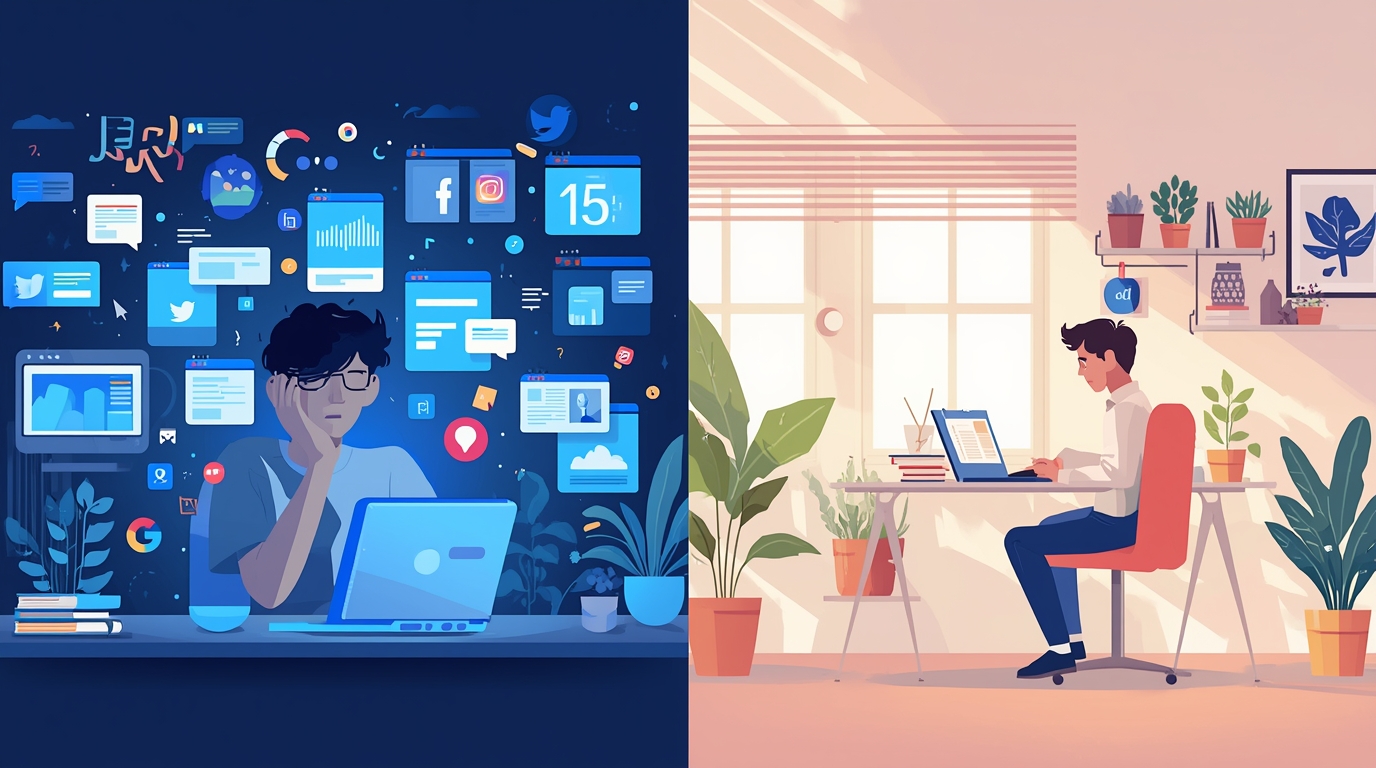
Students are surrounded by screens from the time they wake up until they go to bed. Everything happens on a screen, from classes and homework to talking to others, having fun, and even relaxing. Technology has clearly made studying smarter and easier to get to, but it also has a serious challenge that many students discreetly deal with: digital minimalism for students.
It’s exciting to switch between study applications, YouTube lectures, WhatsApp groups, Instagram, games, and online textbooks, but it may also be too much. A lot of students say they can’t concentrate, don’t have enough energy, have headaches, put things off, and even feel mentally tired. They don’t realize that their smartphone addiction is a large part of the problem.
This is where digital simplicity comes in.
Digital minimalism doesn’t mean getting rid of technology; it means using it on purpose without letting it take over your time, attention, or mental space. This way of thinking can change a student’s life. It can help you get more done, focus more deeply, lower your stress, and make study time much more meaningful.
We’ll talk about what digital minimalism is, why students need it more than ever, and how to cut down on screen time without hurting your academics (and even improve your grades). This guide will show students and parents exactly how to bring balance into academic life with real-world examples, useful tips, and simple methods.
🌱 What is digital minimalism, and why do students need it right now?
Digital minimalism means getting rid of digital habits that aren’t necessary so you may focus on what’s important. It’s not about getting rid of everything; it’s about being purposeful with your technology.
For students, digital minimalism means:
- Only using screens when necessary
- Cutting down on digital distractions
- Making a healthy study schedule
- Not scrolling endlessly
- Putting learning ahead of consuming
- Keeping their minds clear
Students aren’t only studying online anymore; they’re living online too. Online classes, NCERT-based e-learning, YouTube lectures, AI tools, and digital notes are all becoming normal.
📉 The Secret Effects of Too Much Screen Time on Students
Students need to know what smartphone addiction really does to people before they start looking for answers. A lot of people don’t understand how much time they spend online and how much it affects their schoolwork.
1. Shorter attention span
Notifications and scrolling all the time make it harder for the brain to stay focused for lengthy periods of time.
2. Less memory and retention
Research indicates that alternating between applications diminishes the brain’s capacity to retain knowledge.
3. Putting things off becomes a habit
Phones keep the habit loop going: bored → scroll → ignore work → worry.
4. Tiredness of the mind
Spending too much time in front of a screen can make it difficult to study because it takes away cognitive resources.
5. Bad Sleep Quality
Exposure to blue light late at night changes sleep patterns, making you less productive the next day.
6. The end of discipline in real-life studies
Apps take the place of notebooks, videos take the place of teachers, and people’s attention is split.
Digital simplicity can bring back clarity, control, and calm, which helps undo negative impacts.
🌟 How to Be a Digital Minimalist as a Student (Without Hurting Your Studies)
This is the most crucial part: useful tips that will help you do better in school and stop using your phone too much.
These tactics have been broken down into easy-to-follow phases for students.
1. Do a “Digital Audit” first (a five-minute task)
Students need to be able to see their habits before they can change them.
These are the questions you should ask:
- How many hours a day do you spend on your phone?
- Which apps take up the most time?
- What part of the time spent on screens is really “study time”?
- Do you look at your phone while you’re studying?
Most pupils are astonished when they realize their actual numbers.
This thought raises awareness, which is the first step toward digital minimalism.
2. Use the 3-Category Rule: Necessary, Useful, and Addictive
Put apps into three groups:
✔ Category 1: Required Google Classroom, NCERT PDFs, Cogniks, Zoom, Notes, and a calculator.
✔ Category 2: Useful (but not required) YouTube (for learning), ChatGPT, Pinterest (for taking notes), and productivity applications.
✔ Category 3: Addictive Instagram, Snapchat, PUBG/BGMI, Reels, OTT, and TikTok alternatives.
It’s easy to understand digital minimalism:
👉 Limit Category 3
👉 Schedule Category 2
👉 Optimize Category 1
Students shouldn’t get rid of technology that helps them study; they should only get rid of the ones that are getting in the way.
3. Set up a “Low-Distraction Study Area”
Students don’t just need less time in front of screens; they also need help managing their time in front of screens.

A decent digital study setup has:
- Airplane mode or Do Not Disturb
- Only one tab open
- Notes in front (physical or digital)
- Studying with a timer (Pomodoro)
- A dedicated study window on the device
- A clean desktop/home screen.
This helps you stay focused, feel less overwhelmed by technology, and do better in school.
4. Follow the 25–5 Rule (Pomodoro for Students Who Get Easily Distracted)
Boredom is the main reason students stay on screens.

Pomodoro helps:
- 25 minutes of hard work
- 5 minutes of rest (offline is better)
- 1 study session = 4 cycles
Students should NOT check their phones during breaks.
Stretch, drink water, walk, and breathe, but don’t look at screens.
Pomodoro helps you stay focused and makes you much more productive.
5. Change “Doom Scrolling” to “Digital Intentionality”
There should be a reason for every time a pupil pulls up their phone.
Instead of saying something like “Let me check Instagram” or “Let me see a few reels,”
Change to:
- “I’m opening this app to do this.”
- “I’ll only use it for 10 minutes.”
- “I’ll close it when I’m done with the task.”
This makes people act in a regulated way online..
6. Use alternatives that don’t need the internet As often as possible
Digital minimalism is not against technology; it’s for balance.

But students shouldn’t depend on screens for everything.
Do things in real life instead of online:
| Instead of this… | Do this… |
|---|---|
| Watching videos for every question | Read NCERT + Cogniks solutions |
| Digital notes for all subjects | Make handwritten notes |
| Notifications for reminders | Physical to-do list |
| Late-night study on phone | Use printed notes/books |
7. Stick to the 2-Hour Digital Sunset Rule
To get better sleep, students should cut back on screen time two hours before bed.
- Memory
- Focus
- Mood
- How productive you are the next day
In the last two hours:
- Plan for tomorrow
- Read your revision notes
- Solve your written practice
- Do some stretching or meditation.
Sleep gets a lot better, and so does studying.s drastically — and so does study performance.
8. Use mini digital detoxes to build “focus muscles.”
Here are several easy ways to detox:
✔ No phone for one hour after waking up
Don’t check WhatsApp or Instagram right away.
✔ No phones at the table
It helps with digestion and mental clarity.
✔ No technology on weekends in the mornings
Do your homework, go over what you’ve learned, or write in a journal.
✔ Study blocks without a phone
Put your phone outside your room when you need to focus.
Each detox makes you more disciplined and less dependent.
9. Use the “Focus Apps” that cut down on screen time.
Instead of getting rid of everything, try using productivity apps:
- Forest: Grows trees when you don’t use your phone
- Focus To-Do: a Pomodoro timer and a task manager
- Digital Wellbeing: bans apps after a certain amount of time
- Notion and Evernote helped me keep my study plans in order.
These technologies make it easier and more fun to be a digital minimalist.
10. Promote “Family Digital Boundaries”
Parents help students a lot.
Simple rules help:
- no phones at dinner,
- no screens after 10 PM,
- shared study timetables,
- charging devices outside the bedroom, and parents also model limited screen time.
This emotional support makes study spaces healthier.
🌟 How Digital Minimalism Can Help You Do Better in School
When students cut down on digital distractions, a number of things go better, including:
🎯 Better focus
Fewer apps mean fewer things to keep you from getting things done. Learning faster
Study time that is focused is better.
📘 Better understanding of NCERT concepts
Deep focus helps you understand better.
🧠 Better memory retention
Less time in front of a screen means less tiredness and better absorption.
😊 More self-assurance
Students have more control over their time.
🌱 The goal is to have a healthy balance between screen time and life, not to have no screen time at all.
Digital minimalism doesn’t mean getting rid of your phone.
It’s about being in charge.
Screens should help people learn, not take over.
Students need:
- Technology to help them study
- Time to rest for their mental health
- Offline routines to keep things in balance
- Clear rules for discipline
A sensible, healthy balance helps youngsters do better in school, feel calmer, and develop habits that will serve them for the rest of their lives.
🧩 Conclusion: Every Student Should Learn How to Be a Digital Minimalist
In a world full of information, a student’s attentiveness is their most significant commodity.
Digital minimalism helps pupils keep their focus, improve their minds, and develop good study habits.
Students can study better, stay focused, cut down on digital distractions, lower their stress, improve their health, get higher grades, and feel more in charge of their academic path by cutting down on needless screen time, using technology purposefully, and following basic daily routines.
Digital minimalism isn’t simply a “trend.” It’s a skill that helps pupils learn how to study well and have a great future.
Pay attention Digital Minimalism for Students is the main idea.