
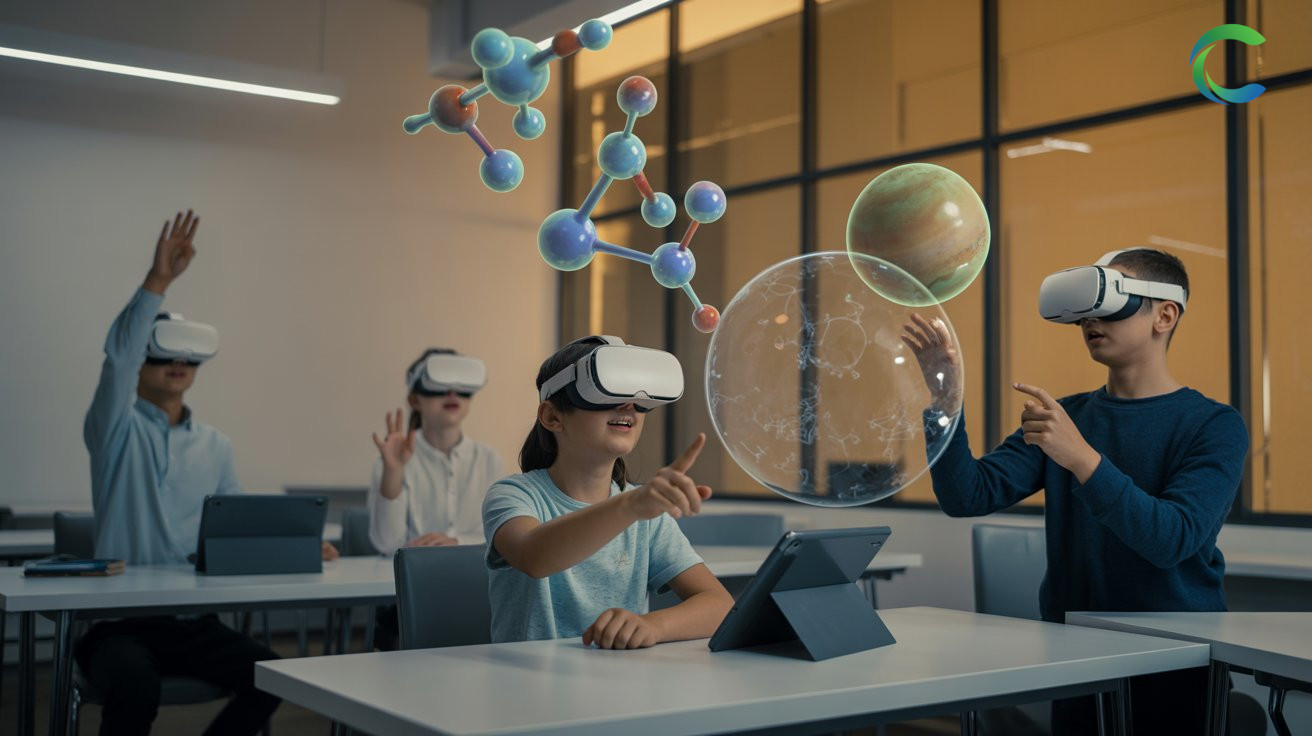
Do you remember looking at that diagram of the human heart in your textbook? All those arrows and labels are aiming to depict how blood moves through the chambers. You would have read it five times, nodded along, and maybe even memorized the bits for the test. But did you really get it? Do you really know what’s going on within your chest?. That’s what we revolutionize using VR and AR in education.
Now picture putting on a headset and being inside that heart. Walking around rooms. You can see valves opening and closing all around you. Watching blood flow by. That’s not science fiction anymore; that’s what VR and AR are doing in classrooms right now.
For students grinding through NCERT syllabi in Class 10 and 12, this technology might change everything. You won’t have to stare at flat schematics anymore to picture 3D shapes. You won’t have to remember steps you can’t see anymore. Instead, you get to do what you’re learning.
This blog explains how augmented reality and virtual reality are changing education by making hard subjects like biology, geography, and arithmetic easier to understand. We’ll talk about what works, what doesn’t, and how students can start using these tools right away.
Why the Old Way Doesn’t Work
Learning the old-fashioned way works. Obviously. Textbooks and lectures taught billions of people. But here’s the thing: it stops working on some subjects.
In Class 12 Maths, learn 3D geometry. You are reading about how vectors and planes cross each other in space. The book has a 2D picture that tries to show 3D space. Your teacher writes on the board. You should be able to picture it turning in your thoughts. Some students can accomplish this without trying. Most people have a hard time.
Or geography, like reading about how tectonic plates move. There are arrows in the textbook that indicate plates sliding past each other. You remember which plates make earthquakes happen. But do you really get the scale? The action? What does it look like when things happen below the surface of the earth?
Biology could be the worst. The text and static illustrations explain DNA structure, cell division, and how organs work. You need to remember things that happen at the microscopic level that you’ll never actually see.
Things are about to become interesting. Studies demonstrate that students learn better and remember things longer when they interact with the material instead of merely reading it. A significant review concluded that using AR and VR in education mostly had good effects, especially when it came to really boosting learning and not just making it more fun.
So the question is: how can pupils go from just reading to really experiencing? That’s where AR school tools and VR classrooms come in. They make things that are hard to see clear. Ideas that are not concrete become real.
What Are Virtual Reality and Augmented Reality in School?
Let’s get rid of the confusion between these two:
- Augmented Reality (AR): Adds digital things to the physical world. If you point your tablet at a page in a textbook, a 3D model will appear on your screen. You can still see your desk and are still in your classroom, but now there is a throbbing heart above your biology book.
- Virtual Reality (VR): A computer-generated reality that completely replaces everything around you. When you put on a headset, you can go anywhere from a human cell to Mars to the ocean floor.

These ideas aren’t new anymore. Schools really do use this stuff. And here’s the good news: AR doesn’t even need pricey gear. Most AR games and apps work well on normal tablets and smartphones that schools may already have.
Studies keep proving that using augmented reality in the classroom helps students learn about space and get more involved. Not just a little amount, but a lot.
Here’s how they stack up in real school use:
| Technology | How It Works in School | Key Benefit |
|---|---|---|
| AR in school education | Overlay 3-D models on textbook diagrams, virtual lab simulations | Bridges reading to visual-experiential learning |
| VR in classroom | Fully immersive simulations (e.g., walking through human heart, virtual field trips) | Deep engagement & stronger memory links |
How VR and AR can help you understand hard topics
Let’s talk about how this technology helps kids with real problems:
1. Making Maths More Visual
Most pupils find 3D geometry in Class 12 to be very hard. Reading about planes that cross each other in space? Can you picture a spherical crossing a cone? There is one static angle in your textbook. Your brain should be able to turn it around.
You can take that shape with your fingertips and turn it around with AR. Get closer. Look at it from every angle. Find out exactly where that plane goes through. All of a sudden, the idea makes sense because you’re not just thinking about it; you’re doing it.
VR goes much further. You might actually walk inside a form. Go from one face to another. Stand at the point where the lines cross. You can’t get that kind of spatial awareness from a textbook diagram.
2. Making Biology Real
It’s one thing to read about heart valves opening and closing. Seeing it happen in real time while you’re virtually inside the heart? A whole different experience.
With AR, you can point a tablet at the heart diagram in your textbook and see it beat. See blood moving through chambers. Watch how valves work. While you are still at your desk.
This isn’t about making biology “fun,” but it is. It’s about figuring out how things work that you can’t see in everyday life. Your brain learns better when you do things than when you read about them. In education, virtual reality and augmented reality make those experiences happen.
3. Geography: Learn About Places Without Leaving Class
Are you learning about tectonic plates? In VR, you can stand on a fault line and see the ground move under your feet. Watch how mountains build over millions of years in just a few minutes. See earthquakes happen from inside the earth.

Want to learn about ecosystems? Use AR to put a rainforest on top of your classroom. See layers of canopy, learn about how species interact with each other, and feel the scale in ways that photos can’t.
These activities don’t simply help you do well on tests; they also help you understand things that will stick with you for years. The distinction between remembering data and really understanding how things function.
What Research Shows About Real-World Evidence
This isn’t simply a theory. Research corroborates educators’ observations in classrooms utilizing this technology.
A comprehensive assessment of augmented and virtual reality in education found “mostly positive outcomes… especially in improving learning.” Not only making learning more fun, but making it better.
Other studies on virtual reality indicated that students who used VR were more interested and remembered what they learned better than students who learned the same things in a more traditional way.
This is what schools are seeing:
- More involvement from students– VR and AR keep people’s attention better than any book or lecture. Students who usually zone out in class can’t stop looking.
- Better remembering what you learn– Immersive experiences make memories stronger. Your brain regards virtual reality experiences more like genuine memories than ideas.
- Help for varied ways of learning– Everyone benefits, whether they learn by seeing, doing, or hearing. Reading isn’t the greatest way for everyone to learn. Some people need to see. Some people need to do. Both VR and AR in education give you this.
How Schools and Teachers Can Start Using Immersive Learning
Most schools don’t have full VR labs. That’s okay. You can start with little and yet get rewards.
Step-by-Step Guide
- Begin with little AR apps: Get free AR apps that go along with NCERT chapters. Chemistry 3D molecular viewers. Apps that let you change the shapes of things for math. Maps that you may use to learn about geography. Most of them operate with regular tablets and phones.
- Plan VR sessions when you can: If your institution has even a few VR headsets, set aside certain days for VR classes. A VR tour of the solar system is better than ten pages of textbook information about planets for Class 10 Science.
- Connect with what you’re learning in class: Don’t use AR or VR for no reason. Connect it directly to what is being taught. Read about how cells divide in the textbook, and then utilize AR to witness it happen right away. The connection makes both experiences stronger.
- Train Teachers: Teachers need to know how to use technology well for it to work. Training on how to use VR and AR in education, how to make them fit with NCERT material, and how to manage tech time in the classroom are all very important.
- Mix with traditional teaching: This is important: immersive technology should not take the role of textbooks and lectures. First, read. Second, experience. Talk about the third thing. That mix works best.
- Evaluate and Grow: Check to see if this really helps students learn. Look at the test scores. Ask students what they think. Then add to what works and get rid of what doesn’t.
Problems and Things to Know About
Let’s be honest about the problems schools will have putting this into action:
- Hardware & Cost: VR headsets cost a lot of money. AR works on tablets, but not all schools have enough iPads for all of their students. Budget cuts impacted hard, especially in public schools.
- Training & Tools: Teachers’ schedules are already filled. Many people don’t have the time to learn new technology. Also, just because you know how to use a VR headset doesn’t mean you know how to apply it in lesson planning.
- Fit with the curriculum: If the VR experience doesn’t fit with the NCERT syllabus, it’s just a waste of time. Schools require content that is particularly designed for their curriculum, not just general educational experiences.
- Fairness and Access: What happens when some students can use devices at home but others can’t? If not used carefully, technology can make gaps bigger instead of less.These problems are real. But they can be overcome. They merely need careful planning, gradual implementation, and partnerships with EdTech firms, government initiatives, or non-profits that operate in education. But these challenges don’t make the tech unusable—they simply mean schools need smart planning, phased roll-out, and partnership with EdTech, government or NGOs.
What Students Can Do Right Now
You don’t have to wait for your school to create a VR lab. Use these tools right away:
- Download free AR apps for your phone or tablet. Look for apps that go along with your current NCERT chapters. Biology apps that display anatomy in 3D. Apps for math that let you change shapes. Geography apps that let you play with maps. Watch 3-D simulations and virtual tours available online (e.g., virtual museum tours, solar system VR experiences).
- You may watch 3D simulations and virtual tours online. You don’t even need a headset to enjoy thousands of VR videos on YouTube. Tours of museums online. Explorations of the solar system. Walkthroughs of historical sites. Form peer-groups for VR and AR in education that promotes study sessions—sharing devices or visiting labs.
- Talk to your teacher about using AR/VR for projects. Suggest using these tools to provide a presentation on the chapter you’re working on right now. Teachers typically like it when students take the lead in trying out new ways of learning.
- Make study groups with other people who are learning VR/AR. Share gadgets with a friend who has a VR headset or tablet. Go to labs together. Work together to learn.
- Think about what you did after utilizing these tools. Don’t just do it and then forget about it. What did I learn? What do you understand better now? How would this help you on tests? That contemplation makes the learning stick.
Conclusion

Right now, people are moving from reading about ideas to really experiencing them. Not in the distant future, but right now, schools are trying out these tools.
VR and AR in education make more immersive, which helps students understand things better, especially in courses where seeing things is important, like arithmetic, biology, and geography. This device is a lifesaver for pupils who have trouble learning abstract NCERT material. When applied correctly, virtual reality and augmented reality are not only gimmicks or distractions. They’re strong tools that assist pupils learn in a way that makes sense instead of just memorizing things that don’t make sense.
Integrating VR and AR in education, studying for board exams, or helping your child learn at home can all be very helpful. Begin small. Put it in line with textbooks. witness how different it is to read about ideas and witness them happen in real life. The truth is that you’ll remember the VR experience of strolling through the human heart long after you’ve forgotten which chapter it came from in a textbook. That memory might be what helps you get the right answer on the test.